Executive brief
Kevin Warsh’s public OGE Form 278e lists DCM Investments 10 LLC at $250,001–$500,000. Beneath that line, the disclosure lists Abstract Holdings LLC and numerous portfolio sub-lines, including multiple crypto, blockchain, decentralized-finance, digital-asset, and web3-connected names. The disclosure also lists THSDFS LLC – Series 36 at $15,001–$50,000, with TravelXchange Inc. described as a blockchain travel platform.
The central question is not whether every listed entity is a coin. The stronger finance-and-policy issue is whether the public can clearly distinguish indirect private investment exposure, personal financial incentives, opaque fund holdings, professional-network ties, and future central-bank judgment.
Current status and background
Federal Reserve role
Federal Reserve sources state that Kevin Warsh took office as chairman of the Board of Governors on May 22, 2026, serves as FOMC chair, and previously served as a Board governor from 2006 to 2011.
Disclosure lens
The relevant filing is a public financial disclosure, not a full look-through economic audit. Value ranges can be broad, many private sub-lines show “N/A,” and some fund holdings remain undisclosed because of pre-existing confidentiality obligations.
Venture exposure is not wallet exposure
Protocols, private companies, investment firms, exchanges, developer platforms, and infrastructure providers can all create digital-asset exposure without proving a direct wallet position in Bitcoin, Ether, Solana, or any governance token.
Why investors care
The Fed shapes interest rates, liquidity, bank supervision, payment rails, and market expectations. Even perceived conflicts can affect confidence when the institution’s credibility depends on independence.
Visual analysis series
Each image opens with additional context connecting the graphic to the verified disclosure record and the broader market-policy question.
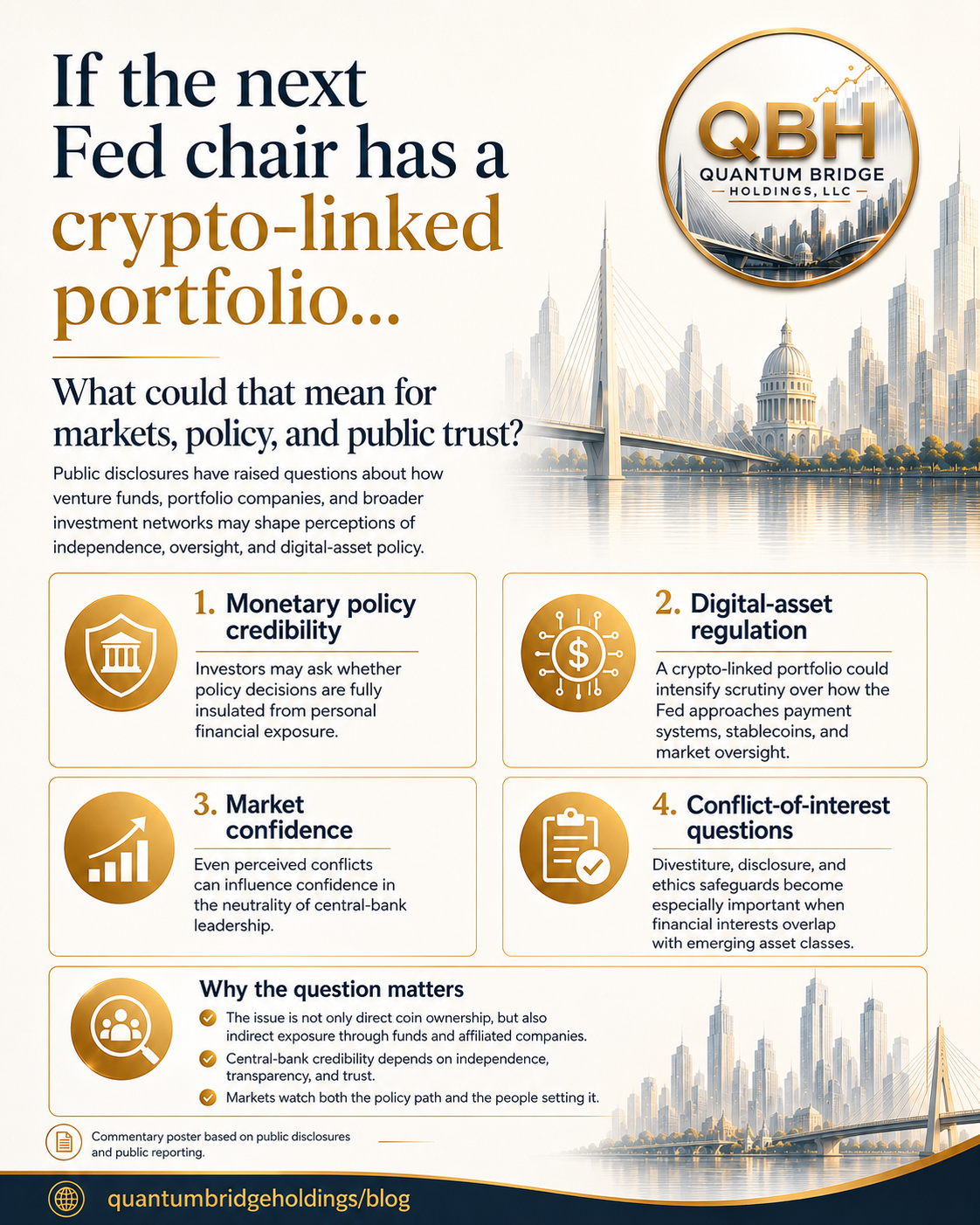
The Fed Credibility Question
A central question for investors: how crypto-linked private exposure can affect market confidence, policy scrutiny, and public trust in central-bank independence.
Policy question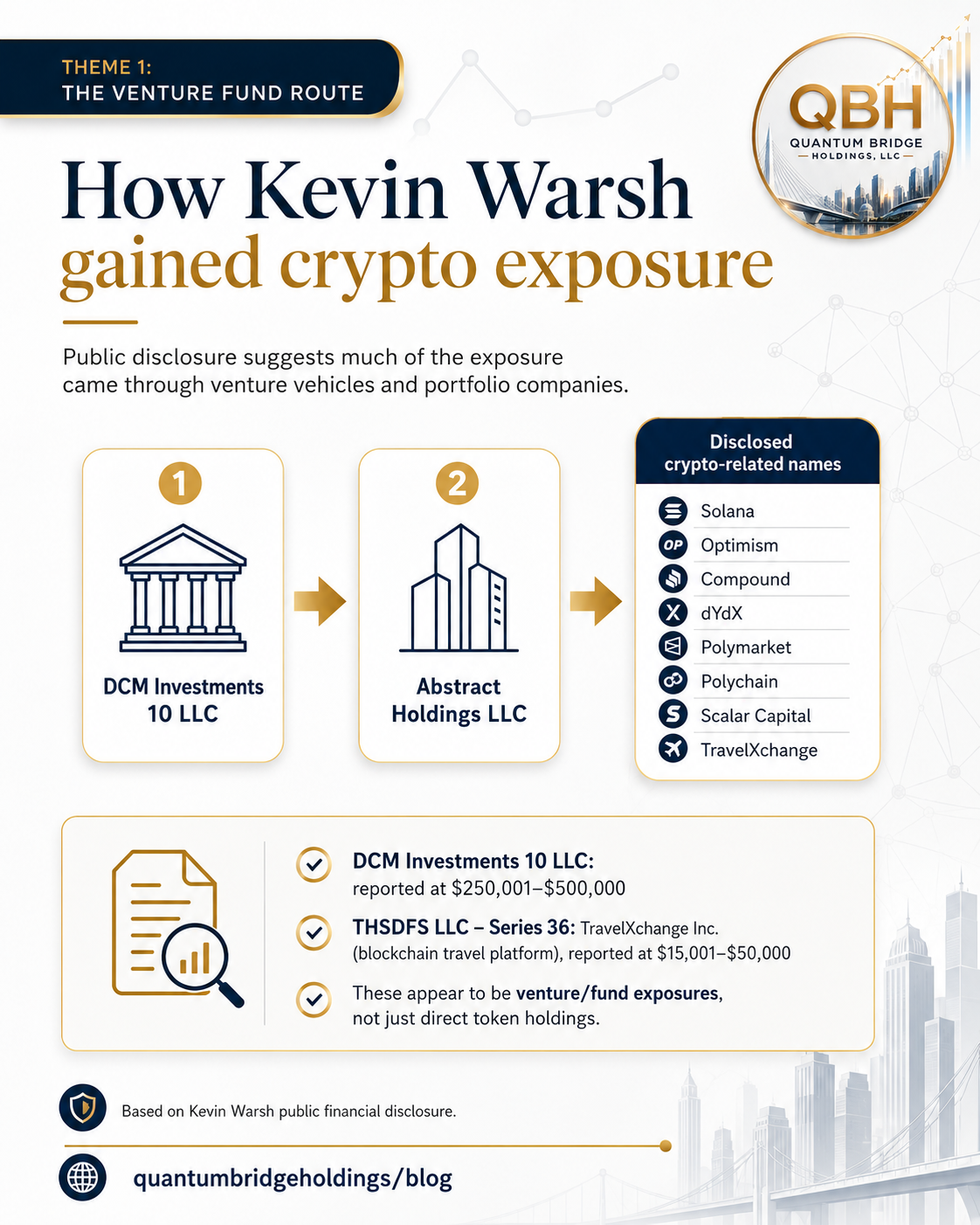
The Venture-Fund Route
Shows the path from a disclosed private investment vehicle to underlying crypto-related and blockchain-connected portfolio names.
Disclosure record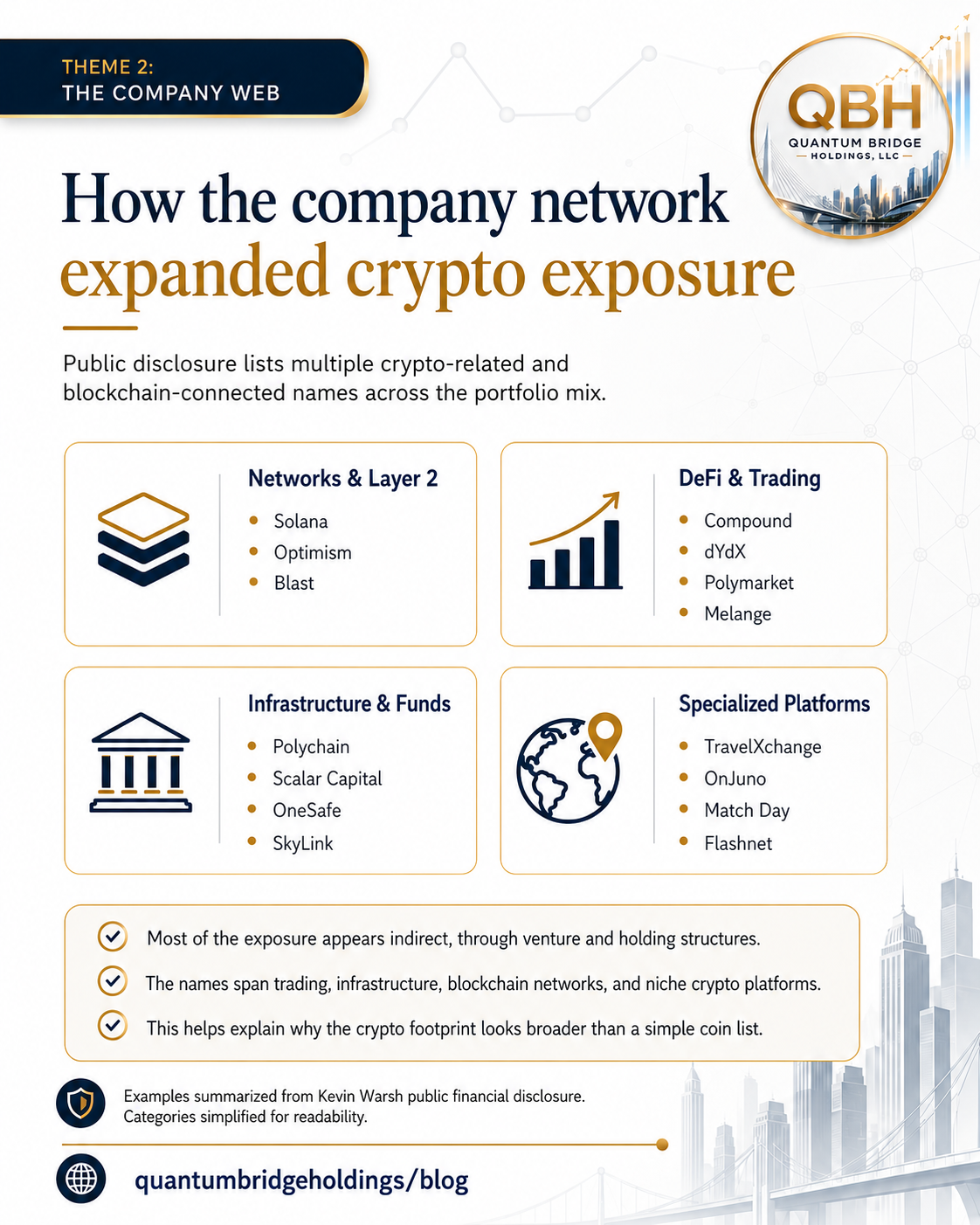
The Portfolio Network
Shows the disclosed names across DeFi, layer-two networks, crypto funds, infrastructure, and specialized blockchain platforms.
Portfolio categories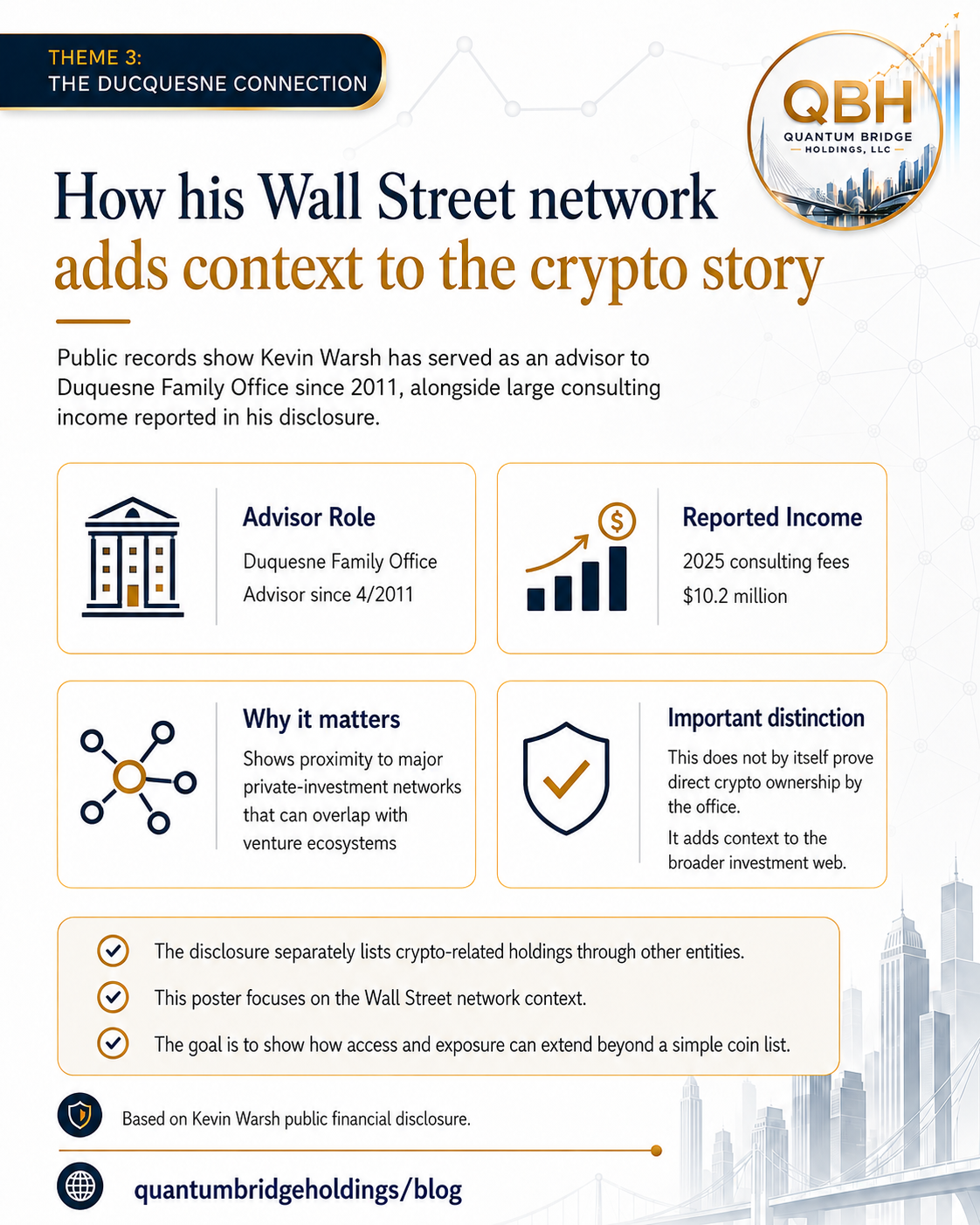
The Duquesne Context
Examines Warsh’s advisory relationship and disclosed consulting income from Duquesne Family Office.
Advisory income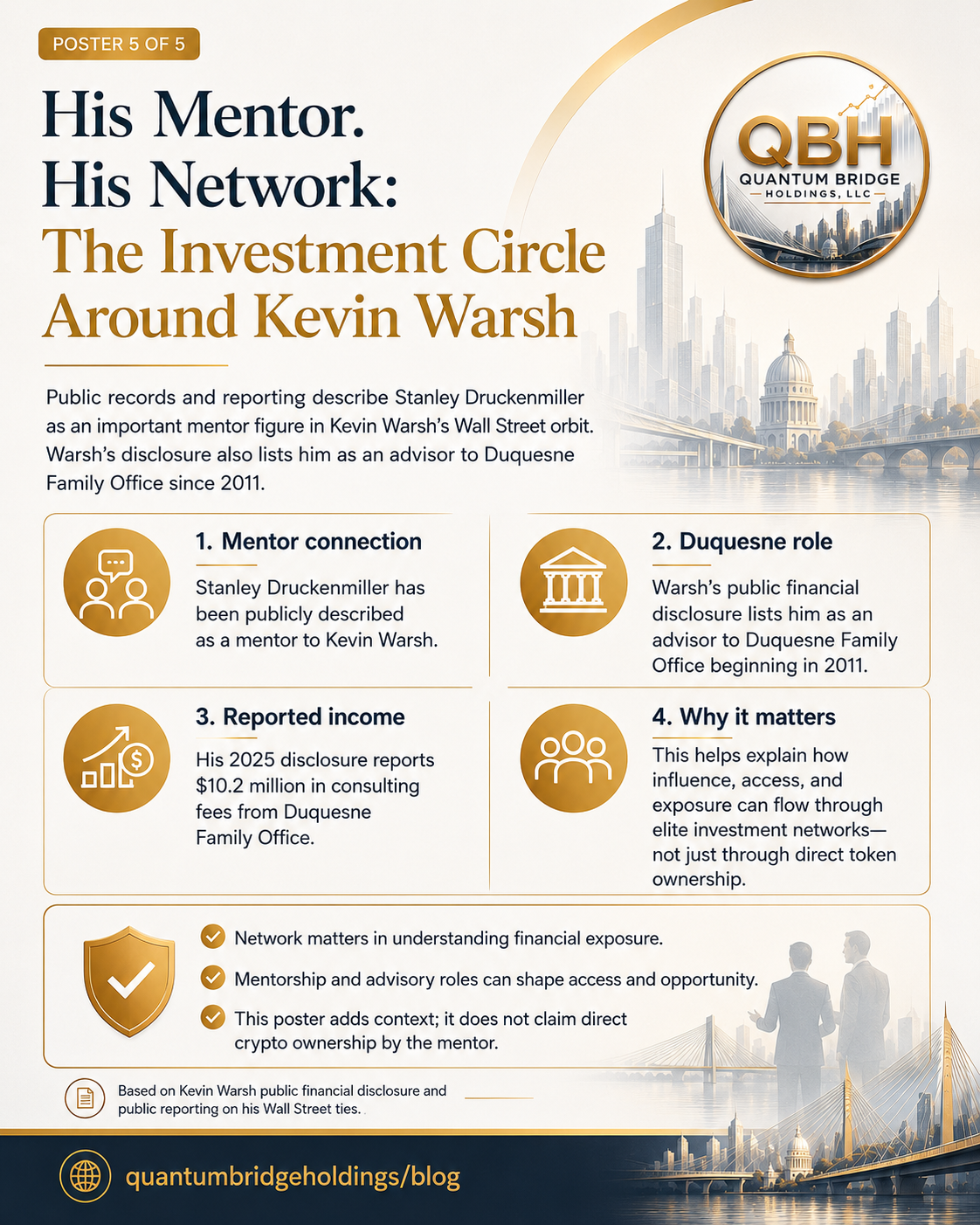
The Investment Circle
Examines why elite investment networks and advisory relationships become part of the public-confidence discussion.
Public trustHow the exposure appears in the disclosure
| Disclosure route | What it shows | Supported interpretation | Unsupported interpretation |
|---|---|---|---|
| DCM Investments 10 LLC | Private investment vehicle with Abstract Holdings LLC beneath it. | Warsh disclosed an interest in DCM Investments 10 LLC, which included crypto-related sub-line items. | The filing does not establish that Warsh personally bought every listed token. |
| Abstract Holdings LLC | Underlying portfolio includes digital-asset, DeFi, blockchain, web3, and related infrastructure names. | Abstract Holdings shows blockchain, DeFi, digital-asset, and crypto-infrastructure exposure. | Not every Abstract holding is necessarily a cryptocurrency. |
| THSDFS Series 36 | TravelXchange Inc. appears as a blockchain travel platform. | A separate blockchain-related position was disclosed through THSDFS LLC – Series 36. | The listed value range does not support describing it as a large crypto holding. |
| Confidential funds | Several private vehicles list underlying assets as undisclosed due to confidentiality agreements. | Some holdings are opaque, which is why transparency questions remain. | The undisclosed holdings cannot be assigned to crypto without evidence. |
Numbers that make the story sharper
Disclosure-value ranges discussed in this article
The bars compare different categories and should not be read as an investment-performance chart. DCM and THSDFS are asset-value ranges; Duquesne is disclosed 2025 consulting income.
Policy-sensitivity map
| Area | Why it matters | Risk type |
|---|---|---|
| Stablecoins / payments | Fed-supervised banks and payment rails affect crypto market structure. | Regulatory |
| Bank custody | Banking rules shape whether institutions can hold or service digital assets. | Supervisory |
| Liquidity and rates | Risk assets often react to Fed policy, real yields, and dollar liquidity. | Market |
| Ethics / divestiture | Trust depends on credible separation from conflicting investments. | Governance |
Crypto-related names appearing in the disclosure
The entries below are cautious editorial categories. Some entries are not coins; they are private companies, funds, protocols, platforms, or infrastructure businesses. “Crypto-linked” is the safest umbrella term.
| Name | Disclosure description or practical category | Why it matters |
|---|---|---|
| Blast | Yield-generating Ethereum layer-two | Layer-two exposure raises questions about Ethereum-scaling infrastructure. |
| Compound | Algorithmic crypto money markets | Clear DeFi lending/borrowing exposure. |
| dYdX | Decentralized derivatives trading exchange | Touches derivatives, leverage, decentralized trading, and market supervision. |
| Polychain | Crypto investment firm | Fund exposure can create diversified crypto-sector sensitivity. |
| Scalar Capital | Blockchain investment firm | Investment-firm exposure tied to blockchain venture ecosystems. |
| Dapper Labs | Consumer digital-assets platform | Relevant to NFTs, consumer collectibles, and digital-asset commercialization. |
| Lighter | Decentralized exchange protocol | Exchange infrastructure touches liquidity and DeFi oversight. |
| Lightning Network | Off-chain payment network | Connects to Bitcoin payment scaling and payment-system policy. |
| Structure / Zaibatsu Heavy Industries | Blockchain retail trading platform | Retail trading infrastructure can matter for market-access debates. |
| OnJuno | Crypto-enabled neobank platform | Connects digital assets with banking-like consumer finance products. |
| OneSafe | DeFi data infrastructure platform | Data, compliance, and analytics sit under the crypto stack. |
| Ridian | Crypto portfolio automation platform | Relevant to crypto investing and trading workflows. |
| SkyLink | DeFi portfolio management platform | Connects to how investors manage decentralized-finance exposure. |
| Flashnet | Lightning Bitcoin trading platform | Connects Bitcoin Lightning infrastructure with trading and payments. |
| Melange | Decentralized prediction market platform | Relevant to prediction markets and regulatory scrutiny. |
| TravelXchange Inc. | Blockchain travel platform | Separately listed through THSDFS LLC – Series 36. |
The Duquesne / Stanley Druckenmiller context
Why this belongs
The Duquesne relationship helps explain why observers focus on elite investment networks, private-fund exposure, and central-bank independence.
What it does not prove
It does not prove that Stanley Druckenmiller selected, owned, or benefited from each crypto-linked line in Warsh’s disclosure.
Jane Lauder context — corrected and fact-checked
Jane Lauder belongs in the article only as household-wealth and public-perception context. Public reporting identifies her as Warsh’s spouse and links her wealth to the Estée Lauder family. That does not prove she directed, selected, or caused the crypto-linked venture exposure.
Safe wording
“Warsh is married to Jane Lauder; that context appears in public reporting on household wealth and disclosure scrutiny.”
Use caution
“Spousal assets may affect public perception of wealth and conflicts, but perception is not proof of influence.”
Avoid
“His wife’s ventures drove the crypto portfolio.” This page found no reliable source proving that statement.
What could it mean for markets, policy, and public trust?
Market confidence
Fed comments and rate decisions can move risk assets. The conflict question is partly legal, but it is also reputational: investors need confidence that policy is insulated from private exposure.
Digital-asset regulation
The Fed affects bank supervision, payment-system access, and the operating environment for institutions that touch stablecoins, custody, and crypto rails.
Monetary-policy credibility
Central-bank credibility depends on public belief that interest-rate and liquidity decisions are made for macroeconomic reasons, not private financial benefit.
Ethics and divestiture
Disclosures, recusals, divestiture timing, and opaque private-fund structures become part of the public-interest question.
Important distinctions
Fact-check matrix
| Claim | Status | Supported conclusion | Primary support |
|---|---|---|---|
| Kevin Warsh is Fed chair as of late June 2026. | Verified | Federal Reserve sources state Warsh took office as chairman on May 22, 2026. | Federal Reserve biography / press release. |
| Warsh previously served on the Fed Board from 2006 to 2011. | Verified | Warsh previously served as a member of the Board of Governors from 2006 to 2011. | Federal Reserve biography. |
| DCM Investments 10 LLC was disclosed at $250,001–$500,000. | Verified | The OGE disclosure lists DCM Investments 10 LLC with that value range. | OGE Form 278e. |
| Abstract Holdings LLC appears under DCM Investments 10 LLC. | Verified | Abstract Holdings LLC appears as a sub-line under DCM Investments 10 LLC. | OGE Form 278e. |
| TravelXchange Inc. appears as a blockchain travel platform. | Verified | TravelXchange Inc. is listed under THSDFS LLC – Series 36 and described as a blockchain travel platform. | OGE Form 278e. |
| Warsh earned $10.2 million from Duquesne Family Office consulting fees. | Verified | The disclosure lists Duquesne Family Office consulting fees of $10,200,000. | OGE Form 278e. |
| Warsh was an advisor to Duquesne Family Office beginning in 2011. | Verified | The disclosure lists Duquesne Family Office, LLC as an advisor role from April 2011 to present. | OGE Form 278e. |
| Warsh’s wife is Joanna Warsh. | False | Public reporting identifies Jane Lauder as Warsh’s spouse; this article uses Jane Lauder. | Forbes profile / public reporting. |
| Warsh personally owned every listed crypto token directly. | Not proven | The supported description is crypto-related exposure through venture, fund, and portfolio-company structures. | OGE disclosure plus secondary reporting. |
| Undisclosed private-fund holdings are definitely crypto. | Not proven | Some holdings remain opaque due to confidentiality obligations, so asset class cannot be assigned without evidence. | OGE disclosure confidentiality notes. |
Sources and verification notes
Factual claims in this article are supported by the sources below or clearly framed as analysis.
- U.S. Office of Government Ethics — Kevin Warsh Public Financial Disclosure Report, OGE Form 278e
Primary source for DCM Investments 10 LLC, Abstract Holdings LLC, THSDFS LLC – Series 36, TravelXchange, Duquesne income, and confidentiality notes. - Federal Reserve — Warsh oath of office and FOMC chair selection
Official confirmation of chair role and FOMC selection. - Federal Reserve History — Kevin M. Warsh biography
Official historical reference for chair term and prior Board service. - Money — Warsh discloses crypto-related investments
Secondary reporting on the DCM/Abstract and TravelXchange structure. - CoinDesk — crypto portfolio explainer
Crypto-specialist reporting on digital-asset names in the disclosure. - Forbes — Jane Lauder profile
Support for spouse identity and Estée Lauder family wealth context. - Federal Reserve — Investment and trading policy FAQ
Background for ethics, trading restrictions, and divestiture relevance. - Federal Reserve — 2022 investment/trading rule changes
Official background on restrictions covering stocks, cryptocurrencies, commodities, derivatives, and other holdings.