

In this report
The midterm election asks a deceptively simple question: who should hold power next? The answer arrives through a ballot that is much more complicated than a national argument about the president. A congressional candidate may help decide the direction of federal spending. A state constitutional amendment may change the rules governing personal freedom. A county tax question may alter a homeowner’s bill. A judge may spend years deciding how the resulting laws apply. Voters can care about all of these choices without treating them as interchangeable.
The general election is November 3, 2026. All 435 voting seats in the United States House of Representatives are up for election, while Senate elections occur under a staggered system. State and local contests depend on where the voter lives. The president and vice president are not being chosen in this midterm election. Those basic distinctions matter because campaign advertising often presents every contest as though it were another presidential election. It is possible to vote with national consequences in mind and still examine the actual duties of the office printed beside a candidate’s name. 1 2
The public mood is more complicated than a slogan about a wave, a backlash, or an exhausted country. Current surveys document economic pressure and partisan differences. They cannot tell us what every household feels. They also cannot turn a national preference into the result of a particular congressional district. A person can dislike the direction of the country and distrust both major parties. Another can support the president but disagree with a local tax proposal. Another can feel discouraged and still intend to vote. Good election coverage leaves room for those combinations.
A country feeling pressure is not a country feeling one thing
A Reuters/Ipsos survey conducted October 16–19 interviewed 1,679 adults. Among its 1,279 registered voters, 47 percent preferred a Democratic congressional candidate and 35 percent a Republican. In that same registered-voter group, 47 percent selected cost of living as the single most important factor from the choices offered. The full adult sample gave President Donald Trump a 31 percent approval rating. These results describe different populations within the same survey; the percentages should not be swapped between them. 6
The useful story is not merely that one party leads a question. It is that household costs provide a common language for political frustration, while people can attach very different explanations to that frustration. A voter may blame federal policy, business pricing, local housing rules, an international disruption, or several forces at once. A poll recording concern does not establish which explanation is correct. Nor does it prove that the respondent supports every policy promoted by the party the respondent currently prefers.
Independent reporting gives context to those findings. Reuters described the October survey as a difficult political environment for the president’s party. That is an assessment of the campaign environment, not an election result. The relevant caution is geographical: voters elect representatives in districts and senators in states. A national advantage does not distribute itself evenly. Where voters live, which candidates are running, and who actually participates remain consequential. 7
There is another distinction worth keeping in view: intensity is not the same thing as happiness. An angry person may be highly motivated. A satisfied person may assume a preferred candidate will win and feel little urgency. A voter may be enthusiastic about casting a ballot because of opposition to an incumbent rather than affection for the challenger. Describing all political energy as optimism would erase that difference.
A useful way to read the mood is to separate three questions. How does a person assess present conditions? What does that person want government to do? How likely is that person to take part in this election? Campaigns try to connect those answers. The connection depends on the person, the policy and the choice available. Someone worried about grocery bills may want a change in trade policy, a tax adjustment, stronger competition enforcement, or less government intervention. The concern alone does not select the remedy.
For readers, the practical consequence is permission to resist oversimplification. You do not need to decide whether the entire country feels hopeful or fearful before studying your ballot. You need to identify the problems that matter to you, determine which offices have relevant authority, and compare the available choices against that authority. National sentiment helps explain the setting. It should not replace your examination of the decision.
Economic sentiment explains pressure without predicting a vote
The University of Michigan’s final October release places its consumer-sentiment index at 48.0, compared with 48.1 in September. Its current-conditions index fell while its expectations index rose. Those are index readings, not percentages of people who are unhappy. Reuters independently reported the release and connected the weak mood to the affordability debate ahead of the election. The economic survey measures perceptions; it does not directly measure which candidate respondents will choose. 37 38
That combination is more informative than a claim that everyone feels worse about everything. People can judge present conditions harshly and still believe the future may improve. They can also feel personal financial strain without changing a partisan preference. A household’s experience, its expectations and its interpretation of responsibility can point in different directions.
Consider the different questions a household might ask when comparing campaign promises. A renter may want to know whether a proposal affects the availability of apartments or only the tax treatment of homeowners. A worker may want a plan for more predictable earnings rather than a small reduction in one charge. A patient may care most about continuity of coverage. A retired homeowner may focus on a local exemption. These different circumstances help explain why a shared concern about affordability can produce different policy priorities.
The distinction also matters when national indicators and personal experience appear to conflict. An aggregate improvement does not mean every household has improved by the same amount. A household’s worsening situation does not by itself establish that every national measure is inaccurate. The responsible comparison asks what is being measured, over which period, and for which population. That approach allows a voter’s experience to be taken seriously without turning one experience into an unsupported description of the entire country.
Campaigns have an incentive to simplify responsibility. The incumbent may emphasize favorable changes, while the challenger emphasizes burdens that remain. Readers can evaluate both presentations by asking for a consistent baseline. Compared with which month or year? Is the number adjusted for changing prices? Is it a total, an average, a median, or a rate? Does it refer to the same population as the claim about household benefit? A figure can be real while the comparison built around it is incomplete.
Political hope deserves the same specificity as political anger. If a candidate promises improvement, identify the action and the expected path from policy to result. If the campaign says circumstances are beyond its control, identify which relevant tools the office still possesses. Neither optimism nor frustration supplies the missing mechanism. The voter needs enough detail to judge whether a proposed response fits the problem.
The most grounded description of the moment is therefore one of documented pressure and unresolved choice. The available surveys establish that economic concerns are prominent and that party preferences differ. They do not establish that voters have reached one uniform judgment about causes, remedies, or trust. The election will record choices among the available options. Understanding the feelings behind those choices requires careful measurement and reporting, rather than a single label applied to the country.
What the polling can establish and what it cannot
Polling measures answers to specific questions at specific times. It does not record the future. Even a carefully designed survey relies on a sample, a questionnaire, participation, weighting, and decisions about the population being described. A finding about adults includes people who may not vote. A finding about registered voters includes people who may not cast a ballot. A likely-voter estimate depends on a model of participation. These categories answer related but different questions.
The Reuters/Ipsos topline reports an overall sampling margin of plus or minus 2.4 percentage points for its adult sample. That figure should not automatically be attached to each subgroup or to a difference between two percentages. Smaller groups have their own uncertainty, and sampling error does not account for every possible source of error. The questionnaire and methodology are therefore part of the evidence, not technical material to discard after reading a headline. 6
Another original record provides a useful example of why wording and population matter. An AP-NORC survey conducted October 8–12 found that 39 percent of its full adult sample expressed a great deal or quite a bit of confidence that midterm votes would be counted accurately. That is a finding about expressed confidence. It is not a measurement of how accurately votes will be counted. Treating public distrust as proof of an inaccurate election would confuse an attitude with an observed event. 8
Campaign coverage can also overread movement. Before calling a small numerical change a surge or collapse, ask whether the survey design, population, question, and field dates are comparable. Two polls can differ without either being dishonest. One may interview adults while the other interviews likely voters. One may offer an undecided option differently. One may include more recent interviews. Comparing them requires attention to those differences.
The same caution applies to the generic congressional ballot. Respondents are usually choosing between party descriptions rather than the exact candidates on their assigned ballot. The question can illuminate national preference. It does not directly evaluate every incumbent, every challenger, every independent candidate, or every local circumstance. It certainly does not determine which candidate will perform well in office.
A reader does not have to become a statistician to use polls responsibly. Look for the organization conducting the research, the interview dates, the number of respondents, the population, the exact question, and the uncertainty statement. Then ask whether the article’s conclusion remains within what those details can support. A poll can justify saying a concern is prominent among respondents. It cannot justify inventing a consensus, announcing an inevitable winner, or assigning motives to every person who disagrees.
Affordability is a real question with several different ballots
When a voter says life costs too much, the ballot may offer several kinds of decisions relevant to that concern. A federal candidate may discuss taxes, trade, competition, benefits, or spending. A governor may propose a state budget or regulatory change. A local candidate may address housing approvals or a municipal service. A ballot measure may adjust a tax exemption. These are different instruments. Their effects depend on design, implementation, and circumstances, not simply on the word affordability.

A serious affordability promise should identify the bill it intends to change. Is the candidate discussing a monthly premium, the price paid at a store, rent, a utility charge, a tax liability, or the cost of borrowing? The next question is who would receive the benefit. A proposal aimed at homeowners may leave renters without a direct tax reduction. A credit may help eligible households while excluding others. A measure may reduce one charge while changing the public revenue used to provide a service. Those are reasons to read the details, not reasons to dismiss relief.
There is also a timing question. A candidate may propose a change that requires legislation, administrative work, or an appropriation before it reaches households. A campaign announcement is not the same thing as an enacted benefit. An enacted program is not the same thing as a payment already received. A reported average saving is not a guarantee for a particular family. Each step deserves its own description.
For comparison, imagine two proposals that promise a lower housing burden. One reduces a tax on an eligible property. The other seeks to increase the supply of housing over time. The first may change the owner’s immediate bill if adopted and implemented as described. The second may depend on financing, construction, demand, and local conditions. The right comparison is not which slogan sounds more compassionate. It is which problem each proposal addresses, how the mechanism works, who bears the cost, and what evidence would show it succeeded.
This is where a voter can ask candidates for something more useful than reassurance. Request a written description, an implementation date, an estimate with assumptions, and a statement of who qualifies. If a candidate says another official caused a price increase, ask for evidence connecting the decision to the change. A price can rise after a policy without that policy explaining the entire increase.
The ballot cannot make every household expense predictable. It can select people who will make consequential decisions about public money and rules. The reasonable standard is therefore neither a promise of instant relief nor resignation that elections do not matter. It is a clear connection between an office’s authority, a proposed action, and a testable claim about the result.
The president is central to the argument but is not a midterm candidate


Donald Trump is the president and JD Vance is the vice president. The White House identifies them in those offices. Their administration is central to the national campaign argument, but the November midterm does not ask voters to choose a president or vice president. A vote for Congress can affect the administration’s ability to obtain legislation, funding, or confirmations. It does not itself replace the executive branch. 9 1
That distinction is easy to lose when a congressional candidate frames a race as complete loyalty to the president or complete opposition to him. Alignment can be a legitimate consideration. It tells voters something about a candidate’s likely coalition. It is still appropriate to ask how that alignment would translate into a particular vote, a committee priority, or a response to an executive action.
For a voter who supports the administration, the practical question is which part of the agenda a candidate would advance and through what authority. For a voter seeking a check on the administration, the question is which form of oversight or legislative restraint the candidate would pursue. For someone dissatisfied with both major parties, the question may be whether any candidate offers a credible independent position and a workable explanation of how to act on it.
A president can influence the political conversation without being able to dictate every congressional outcome. Members have their own constituencies, legal duties, institutional incentives, and views. Party alignment is informative, but it should not be treated as an individual roll-call record. When evaluating something a member already did, use the member’s actual vote. When evaluating something the member might do, label the assessment as a forecast rather than a fact.
The vice president has a specific constitutional relationship to the Senate: presiding as its president and voting when senators are equally divided. That makes the balance of Senate seats relevant to the administration’s governing position. It does not mean the vice president casts an ordinary vote on every Senate question. It also does not eliminate the procedural requirements that may apply before a final vote occurs. 2
Readers should therefore keep two thoughts together. Midterms can materially alter the conditions under which a president governs. They are also elections for offices with their own responsibilities. Reducing every candidate to a presidential proxy can obscure competence, constituent service, ethics, and the actual decisions the candidate will be empowered to make. A voter can judge the administration and still insist on evaluating the person whose name is on the ballot.
The House determines much more than the television argument


The House is the part of Congress for which every voting seat is up for election in this election. Members serve two-year terms. A voter generally selects the representative for the district containing the voter’s residence, rather than choosing among all House candidates in a state. The office is federal. A state representative with a similar title belongs to a different legislature and votes on a different set of laws. 1
The House participates in making federal law, and revenue bills originate there under the Constitution. Legislation generally must also pass the Senate and be presented to the president before becoming law. That is why a House campaign promise to enact a national policy should come with an explanation of how the candidate expects to move it through the rest of the process. Winning one seat provides a vote and a platform; it does not provide unilateral lawmaking authority. 2
The current House leadership page identifies Mike Johnson as speaker and Hakeem Jeffries as Democratic leader. The speaker is elected by the House. Voters outside their districts do not find a nationwide contest for speaker on their ballots. Their own House election can influence which coalition organizes the next chamber, but the subsequent leadership decision belongs to members. 10
For a voter, House control can matter because a majority’s organizing choices influence the institution’s priorities and committee leadership. The more immediate question is what a particular candidate would try to accomplish within that structure. Ask which committee work would suit the district’s needs, which legislation the candidate would pursue, and what evidence would guide oversight. A candidate who speaks vividly about national conflict should still be able to discuss the work of representation.
Constituent service deserves attention without being confused with favoritism. A congressional office can help a constituent navigate a federal agency’s process, but a candidate should not promise a preferred outcome outside the law. Ask how the office would handle requests fairly, maintain privacy, and communicate when the agency rather than the representative controls the decision. This is one practical way to evaluate whether a campaign understands the office it seeks.
When studying an incumbent, distinguish sponsoring a bill, voting for it, helping negotiate it, and overseeing its implementation. Those activities may all matter, but they are not identical. A candidate’s statement that the candidate delivered a result should identify the relevant action and the evidence of the result. The House ballot is a choice about national direction and about who will perform a demanding, specific job. Both parts deserve examination.
The Senate ballot depends on the seat and the state

The Senate has two members from each state, serving staggered six-year terms. Its Class II seats have terms ending January 3, 2027. The staggered arrangement is why a Senate contest does not appear on every voter’s ballot in every midterm. Special elections can add contests outside the regular class schedule. A voter should distinguish a regular full-term contest from a special election for the remainder of a term whenever the ballot includes that distinction. 1 11
A senator represents an entire state rather than one House district. The Senate shares legislative responsibilities with the House and has additional constitutional roles involving nominations, treaties, and impeachment trials. Those responsibilities can make a Senate election consequential even when the candidate spends most campaign appearances discussing a single local concern. A voter is selecting someone who may be asked to decide issues far beyond the subject that first attracted attention. 2
The public debate often treats Senate control as a simple count of party labels. The count matters, but a senator is also an individual decision maker. A member may support a party’s leadership and disagree with it on a particular bill. An independent may organize with a party for institutional purposes without becoming a member of that party. A forecast about a governing coalition should explain those assumptions rather than silently treating every label as a complete voting record.
For comparison, ask candidates three kinds of questions. Which national laws would they support or oppose? What standards would they use to evaluate executive and judicial nominees? How would they balance the state’s interests with their responsibilities in a national legislature? A strong answer should acknowledge that an appointment vote is different from a spending vote and that a promise to introduce legislation is different from a promise that it will pass.
Senate candidates also need to explain what they mean by independence. The word can refer to a ballot label, a willingness to break with party leaders, or a general campaign identity. Those meanings should not be blurred. The useful evidence for an incumbent is the actual record. For a challenger, it is the specificity and consistency of the position, together with an understanding of the procedures required to act on it.
Finally, a national Senate forecast does not relieve voters of studying their own contest. The candidates, available choices, term, and voting method are established locally under the applicable rules. An article can explain why a state is receiving attention. The official ballot establishes who is actually running and what the voter is being asked to decide. Those sources perform different jobs, and both are necessary for responsible coverage.
A majority is not a guarantee that every promise becomes law
The phrase take control can suggest that one election gives a party unrestricted power. The federal system does not work that way. The Constitution divides lawmaking between two chambers and provides a presidential role in enactment. It also specifies a process for overriding a veto. Elections change who occupies those institutions; they do not erase the institutions. 2
The Senate adds a procedural distinction that campaign shorthand often misses. Its account of cloture explains the three-fifths threshold, ordinarily 60 senators in a fully constituted 100-member Senate, for ending debate under the general rule. That is not the same thing as saying every Senate decision requires 60 votes. The procedure, the kind of business, and applicable exceptions matter. The honest explanation of a legislative promise identifies the relevant route rather than attaching one number to every situation. 12
For voters, the important question is what the candidate’s plan assumes about cooperation. Does the proposal require support from the other chamber? Does it depend on the president signing it? Would it need additional administrative work? Is the candidate advocating a rule change, or describing what can happen under current rules? These questions are not invitations to make excuses. They are a way to distinguish a plausible strategy from a promise that hides the necessary steps.
Consider a hypothetical candidate who promises an immediate nationwide benefit after winning a Senate seat. A useful follow-up asks for the bill, the funding source, the other institutions needed, and the earliest realistic implementation date. A second candidate who says nothing can be done should face an equally demanding question: what authority would the office possess, and why would the candidate decline to use it? Institutional limits should sharpen accountability, not dissolve it.
The same logic applies to divided government. A party can gain the ability to block an action without gaining the ability to enact its preferred alternative. A chamber can conduct oversight without obtaining agreement on a replacement policy. A veto can stop legislation without settling the underlying dispute. Voters may favor those checks, but they should understand the result being promised.
This is also why an election result should not be treated as a public endorsement of every item in a party platform. A ballot offers choices among candidates and measures, often with competing considerations. It rarely asks voters to approve a single complete governing package. Winning provides legal authority under the rules. A claim about a sweeping public mandate is a political interpretation that should be evaluated as such.
Oversight and impeachment are different from an election result
The House has the constitutional power of impeachment, while the Senate tries impeachments. Conviction requires two-thirds of senators present. Those are distinct institutional steps. Electing a congressional majority is not an impeachment vote, and impeachment by the House is not itself removal from office. A campaign can advocate an inquiry or impeachment, but advocacy must not be described as an outcome that has already occurred. 2
Oversight has value apart from the most dramatic possible remedy. It can test whether public money was spent as authorized, whether an agency followed the law, whether officials have conflicts of interest, or whether a program achieved its stated purpose. The standard should be evidence and fair process. A hearing is not automatically proof that the person called to testify committed wrongdoing. An unanswered question is not automatically an exoneration either.
Voters can apply the same standards to both parties. Ask whether a candidate would support disclosure when politically inconvenient, distinguish allegations from findings, and correct an accusation if the evidence changes. Ask whether the candidate can identify the underlying document rather than relying on a social-media clip. The purpose is not to drain moral judgment from politics. It is to ensure the judgment rests on something that can be examined.
There is also a budget question behind oversight. A candidate who promises to eliminate waste should explain what counts as waste and how an investigation would establish it. Disagreement with a program’s purpose is not identical to fraud. A lawful expenditure can be controversial. An unlawful expenditure can occur in a popular program. Voters deserve language precise enough to distinguish those cases.
The same care should apply after the election. If control changes, the new majority’s intentions will be news. Its first announcements will not prove that promised investigations produced findings or that proposed remedies became law. The work of accountability is a sequence of actions and evidence. Voters should be able to follow that sequence without being asked to accept a campaign’s conclusion in advance.
Texas shows the difference between a certified field and a campaign frame


Texas’s final ballot certification, dated August 28, lists Ken Paxton as the Republican Senate candidate, James Talarico as the Democratic candidate, and Ted Brown as the Libertarian candidate. A two-person debate about the race does not make the third certified candidate disappear. The certification establishes the field; it does not establish the truth of any candidate’s criticism of an opponent or predict the result. 13
Paxton’s campaign describes an agenda aligned with Trump, including tax cuts, border enforcement, and deregulation. Talarico’s campaign presents a challenge to concentrated political power and corruption. Those are attributable descriptions of how the candidates present themselves. They should not be converted into independent findings that one candidate will deliver prosperity or that an opponent is corrupt. The campaigns are original sources for their stated priorities, not neutral arbiters of each other’s conduct. 14 15
Associated Press reporting describes contrasting appeals in the race, including Paxton’s emphasis on conservative allegiance and Talarico’s emphasis on hope and affordability. That reporting helps explain the campaign’s tone. It does not establish how all Texans feel or settle which policies would work. A national reader can learn from the contrast without assuming that Texas represents every state. 16
The policy test for each candidate is the same. If taxes are to be reduced, which taxes, for whom, at what cost, and with what spending consequences? If border enforcement is to change, what statutory authority and funding would be used? If corruption is the concern, what disclosure, enforcement, and ethics rules would the candidate support for allies as well as opponents? If energy policy is the proposed route to lower prices, how would the candidate evaluate the eventual household result?
Voters should also keep the office straight. This is a contest for a United States Senate seat. Work performed in a state office can be relevant evidence of experience, but the federal Senate has a different set of powers. An action a state official could take alone may require a federal statute, confirmation vote, or coalition in Washington. The candidate should explain that transition rather than relying on a familiar reputation.
Brown’s place on the certified ballot means Texas voters have three named choices in this Senate contest. Comparing the major-party campaigns is only part of evaluating that field. The candidates share the same prospective federal responsibilities, regardless of party. Consider their stated priorities alongside the powers of a senator, and use the county’s assigned ballot to confirm the complete set of choices. 13
Georgia provides a second test of candidate accountability


Official county sample ballots in Georgia list Republican Mike Collins and Democratic incumbent Jon Ossoff for United States Senate. The same documents also contain other federal, state, and local contests. The Senate race is one decision within a longer ballot. A composite county ballot may include districts that do not apply to every county resident, so its list should not be mistaken for one voter’s assigned choices. 17 18
For an incumbent senator, the central evidence includes the record of Senate service: votes, legislation, committee work, and documented oversight. For a challenger who has served in the House, the relevant legislative record belongs to that chamber. Comparing the two requires identifying the institution and the actual action. A Senate vote and a House vote on related legislation are not automatically votes on identical text.
Ossoff’s official Senate biography emphasizes health care, infrastructure, manufacturing, veterans, and military families. That page establishes the subjects his office highlights. Its claims of accomplishments require the same scrutiny as any other officeholder’s self-description. It is appropriate to ask for the relevant law, project record, appropriation, or implementation evidence before assigning personal credit for a broad outcome. 19
Collins’s candidacy should be evaluated with equivalent discipline. A campaign statement supporting an administration policy is evidence of a stated position. It is not a substitute for the representative’s roll call on a particular bill. If an advertisement says a candidate voted against a benefit, the useful next step is to examine the bill, amendment, procedural stage, and individual vote. If the advertisement instead refers to a proposal on which no vote occurred, that distinction belongs in the explanation.
Georgia’s ballot is useful to a nationwide audience because it shows how easily attention can narrow. The Senate contest attracts national interest, while the same voter may also be deciding how judges are elected or how emergency communications money can be dedicated. Those questions concern different institutions and deserve separate judgments. Supporting a Senate candidate does not logically require supporting every constitutional amendment appearing farther down the page.
The best comparison therefore combines record, policy, and competence. What has the candidate actually done? What would the candidate now support? How would the candidate use the Senate’s particular powers? What evidence would lead the candidate to revise a position? A voter should be able to ask those questions without accepting either campaign’s preferred characterization of the other person. The race’s national significance makes scrutiny more important, not less. The office being sought is a six-year responsibility, and the evaluation should extend beyond the most memorable campaign exchange.
Governors shape the state government people actually encounter
A governor is a state executive, not a federal legislator. The National Governors Association’s election directory lists gubernatorial contests for 2026 and distinguishes states and territories. Readers should use that directory or their state election office to determine whether a governor’s race applies to them. A national reference to gubernatorial elections is not a statement that every state elects a governor this year. 20
The governor’s precise authority comes from the state’s constitution and laws. That means a candidate’s promise needs a state-specific examination. Does the governor control the relevant appointment? Must the legislature approve the spending? Does an independent board make the decision? Does the proposal involve a local government? A confident speech cannot transfer authority from one institution to another.
For voters focused on daily life, the state executive can be a useful place to connect campaign language with administration. Ask how the candidate would manage agencies, evaluate performance, respond to emergencies, and work with a legislature that may disagree. Leadership includes making choices, but it also includes implementing lawful choices reliably. An ambitious proposal can fail if the responsible administration cannot explain eligibility, processing, staffing, or oversight.
A budget promise should identify whether the candidate is discussing a recommendation, an enacted appropriation, or actual spending. These stages can differ. A proposed allocation does not establish that a program received money. An appropriation does not establish that every dollar was spent. Spending does not establish that the program achieved its intended outcome. Voters can support a goal while still demanding evidence at each step.
The same principle applies to emergency leadership. A candidate may promise faster recovery, stronger preparedness, or better coordination. Ask what administrative change would produce that improvement and how it would be measured. A useful answer might identify reporting requirements, mutual-aid coordination, procurement rules, or agency responsibilities. The question is not whether the candidate can make every disaster harmless. It is whether the candidate understands the part of government the office would lead.
Finally, voters should distinguish a state policy dispute from a federal one. A governor may advocate a change in Washington without being able to enact it. A governor may challenge a federal action through available legal channels without guaranteeing a court result. The office can be influential without being all-powerful. Evaluating that influence accurately helps voters recognize both an unrealistic promise and a meaningful opportunity for change. A governor’s race deserves attention on its own terms, even when national personalities dominate the surrounding conversation.
State legislatures are where broad ideas become specific rules
A state legislature is distinct from Congress. Its members make state law within the applicable constitutional framework. USA.gov’s overview notes the legislative, executive, and judicial roles found in state and local government, while emphasizing that organization varies by jurisdiction. Voters should read the full office title so a state House contest is not confused with a United States House contest. 21
State legislative races can receive less attention than statewide races even when the policy arguments are closely connected. The analytical question is straightforward: which institution can write or change the relevant rule? If the issue is governed by state law, a candidate for state legislature should explain the proposed text and the coalition required to pass it. A federal candidate’s sympathy may be politically relevant but does not substitute for that legislative action.

A useful comparison begins with the law as it stands. What does the candidate want to preserve, repeal, amend, or add? Which people would be covered? Which agency or court would apply the rule? What discretion would remain? A proposal that sounds simple in a campaign can become complicated when exceptions, definitions, enforcement, and funding are specified. That complexity is a reason to demand a clear explanation, not a reason to stop examining the proposal.
Voters can also ask how a candidate would handle the relationship between state and local authority. When should a state set a uniform rule, and when should a community retain discretion? The answer may vary by issue. What matters is whether the candidate applies a coherent principle or treats local control as valuable only when local officials agree. A platform should make that judgment visible.
For incumbents, individual votes are essential. A chamber’s final tally cannot establish how one member voted. A vote on an amendment cannot automatically be described as the member’s vote on final passage. A vote to advance debate is not necessarily a vote for the final policy. The record should identify the date, measure, stage, and member. If any of those details is missing, the claim needs more work.
The state legislature also offers a place to assess follow-through. If a candidate promises transparency, ask whether that means timely public documents, understandable fiscal notes, accessible hearings, or another enforceable practice. If the promise is fiscal restraint, ask which spending would change and which services would be affected. If it is expanded access, ask how the proposal would be administered. The meaningful difference between candidates may lie in those operational details rather than in the broad goals both say they share.
Attorneys general and other state offices require a job description
The titles farther down a statewide ballot can conceal substantial differences in responsibility. Attorney general, secretary of state, treasurer, auditor, insurance commissioner, agriculture commissioner, and education offices do not have one uniform national job description. Their authority and selection method depend on state law. The official sample ballot establishes which offices are being contested; the relevant state office and legal framework establish what each job can do. 21
For an attorney general’s race, voters can examine the candidate’s account of legal enforcement, litigation, conflicts, and independence. The question is not simply whether the candidate promises to fight. Fight whom, under which law, on what evidence, and with what standards for bringing or declining a case? An allegation is not a judgment. Filing litigation is not winning it. A settlement is not automatically an admission unless its terms say so. Those distinctions should apply to the candidate’s claims about the candidate’s own work and an opponent’s record.
For an election-administration office, ask which election duties the office actually performs and which remain with county or local officials. A candidate should explain how accurate records, accessible information, lawful procedures, and security would be supported. A promise to ensure trust is incomplete without a description of observable practices. Trust can be a goal; documented compliance and transparent correction of problems are ways to evaluate performance.
For financial offices, separate custody, investment, accounting, budgeting, auditing, and taxation. A treasurer may not control the same decisions as an auditor. An auditor’s report may identify a problem without itself authorizing a spending change. A candidate should describe the office’s legal role rather than borrowing authority from another part of government. Voters deserve to know what the promised intervention would actually involve.
An insurance or agriculture title also calls for specificity. Ask which regulated activities fall within the office, what enforcement tools exist, how complaints are handled, and how the candidate would balance competing obligations. The details will differ by state. A nationwide guide can provide the questions; it cannot responsibly invent one answer that applies everywhere.
These offices are an opportunity to evaluate competence as well as ideology. A voter can agree with a candidate’s general philosophy and still ask whether the candidate understands records management, staffing, procurement, legal limits, and public communication. Technical competence is not separate from public accountability. It determines whether an office can carry out its lawful responsibilities and explain its decisions to the people affected.
Judicial elections are choices about judgment and legal authority

State and local judicial contests can appear as races between candidates or as retention questions, depending on the jurisdiction. Their presence and format must be checked against the assigned ballot. USA.gov identifies state and local judges as a category of elected officials where the applicable system provides for elections. The selection system and the powers of the particular court determine the choice voters are making. 21
A judicial candidate is not running to exercise the same power as a legislator. The relevant evaluation includes legal qualifications, professional conduct, fairness, and the role of precedent and governing law. Voters may also examine how the candidate describes judicial restraint, independence, access to courts, and the treatment of people appearing before the court. A promise to decide every future dispute for one political side is different from a principled explanation of judicial method.
For an incumbent judge, a decision deserves to be read in context. What question was before the court? What did the court decide? Was the ruling procedural or on the merits? Was it a majority opinion, a concurrence, or a dissent? Did the court have jurisdiction to address the broader issue discussed in the campaign? A headline can simplify a complex case, but it should not change what the court actually held.
The same caution applies to claims about sentencing or case outcomes. One decision may reflect statutory constraints, a negotiated plea, evidentiary limits, or a higher court’s direction. Those factors do not prevent criticism. They help identify what the judge was responsible for. A fair critique should separate discretion the judge possessed from a result the judge was legally required to reach.
The federal Supreme Court does not appear as a direct popular-election contest on the midterm ballot. Federal appointments are made through a separate constitutional process involving presidential nomination and Senate advice and consent. Senate elections can therefore have indirect consequences for federal judicial appointments, while a state judicial election directly concerns a different office. Both may matter to the voter, but the routes of influence should be described accurately. 2
For unfamiliar races, seek the official candidate list, available professional evaluations, disciplinary records where relevant, and the candidates’ own explanations of the court’s work. Avoid treating a party label or endorsement as a complete legal résumé. The decision is about who will exercise judgment under law, often in disputes involving people who cannot choose whether to encounter the court. That responsibility merits careful attention even when the campaign receives little airtime.
County and city offices connect authority to a place
Local government is where an address becomes especially important. A city boundary, county district, special district, or school district can determine which contests apply. USA.gov notes that local legislative bodies may decide budgets, zoning, land use, tax rates, and other initiatives, while executive officials generally enforce the laws and policies their institutions adopt. The particular allocation of authority depends on the jurisdiction. 21
Local development decisions can involve agreements, tax incentives, utility arrangements and projected community benefits. Each has a different significance for residents. A council vote may authorize an agreement without demonstrating that its projected benefits have occurred. Construction plans describe intended work; operating records establish whether a facility is functioning. A promised payment is different from money received. Voters evaluating local leadership can compare the agreement, the implementation timetable and the evidence of delivery before assigning credit or blame.
For a local candidate, ask how decisions would be documented and explained. Would residents be able to obtain the agreement, understand the fiscal assumptions, identify enforceable obligations, and track compliance? If a candidate supports a project, what conditions would the candidate require? If the candidate opposes it, what alternative would the candidate pursue and how would that alternative be financed or implemented? Opposition and support both deserve an operational explanation.
The same care applies to campaign claims about individual votes. A council’s overall tally cannot tell you how one official voted. A statement made at a hearing is not a roll call. A vote on one version of an agreement is not automatically a vote on a later revision. When the record includes multiple meetings, amendments, or procedural motions, the chronology belongs in the account.
For public safety, sanitation, streets, parks, and other local services, voters should identify the responsible body before assigning credit or blame. A mayor may share authority with a council, manager, county agency, or independent board. A local candidate should be able to describe that arrangement in plain language. Complexity should not become a shield against accountability, but accountability should land on the institution that actually made the decision.
Local races can also test whether a candidate understands the difference between one-time money and recurring commitments. A temporary receipt may support a project without sustaining its annual operations. A lower charge may help residents while requiring a spending adjustment. A new facility may create future maintenance obligations. Voters do not need to accept or reject every such commitment in advance. They need enough information to judge the bargain being proposed for their community.
Schools and special districts deserve their own examination
A school-board contest or special-district question can look modest beside a Senate race. The responsible comparison is not the amount of national attention each receives. It is the decision each institution is authorized to make. A voter should identify the district, the office or question, and the relevant responsibilities before relying on a general political impression. The assigned sample ballot is the starting point for that identification. 3
For a school-board candidate, ask about the relationship among the board, superintendent, staff, state requirements, and public funding. Which decisions would the candidate vote on directly? Which would remain administrative? How would the candidate evaluate student outcomes, financial stewardship, facilities, and public access to decisions? A campaign should explain how its priorities fit the board’s actual role.
Claims about school money require particular care. An operating budget is not the same thing as a construction budget. A bond authorization is not a completed building. A grant announcement is not necessarily a recurring source of support. An enrollment projection is not an observed enrollment count. A comparison should identify the year, the unit, the source, and any important restriction on the money.
The same method works for a library, fire, water, transit, or other special district when such an entity appears on a ballot. What service does the district provide? Which geographic area does it serve? Is the voter choosing a person, authorizing borrowing, approving a tax, renewing an existing levy, or deciding another legal question? Similar-looking ballot lines can ask fundamentally different things.
A hypothetical renewal illustrates the point. A proposal described as maintaining services might extend an existing tax rather than create a new one. That does not make the question unimportant. It means the voter should compare the continuation with the legal and financial consequences of expiration. Conversely, a proposal described as no increase may still authorize a longer commitment or rely on changing property values. Only the actual text and fiscal explanation can settle what is being requested.
For these contests, concrete questions are more valuable than a generic instruction to pay attention down the ballot. Ask for the spending plan, the oversight process, the term of any authorization, and the evidence used to set priorities. Ask what would happen if the measure fails. Ask whether the candidate or sponsor is describing a legal requirement or a discretionary intention. Those details allow voters to evaluate a public service without having to accept a campaign’s preferred emotional frame.
Utility bills and infrastructure arguments cross several jurisdictions
A campaign promise about electricity, water, or infrastructure should begin with the responsible decision maker. Some questions concern local ownership or service. Others concern a state regulator, a legislature, a federal agency, or a private provider operating under applicable rules. The ballot may offer a direct contest for a relevant office, an indirect choice about appointments or law, or no direct vote on a particular rate decision. Readers should verify the authority rather than assume it from the candidate’s title.
The Georgia sample ballots provide a concrete example by listing public service commissioner contests alongside other statewide races. That establishes that those offices appear in the documented election. It does not by itself explain every power of the commission or establish that one candidate can set an individual customer’s bill. A proper evaluation pairs the ballot with the commission’s legal responsibilities and the particular proceeding at issue. 17 18
For a development or data-center debate, voters can ask who would pay for new infrastructure, which commitments are enforceable, what information would be public, and which agency would review the relevant permits or rates. A statement that a project will pay its own way should identify the agreement and the categories of cost covered. A statement that residents will bear the cost should identify the mechanism and supporting estimate. Neither conclusion should rest on the existence of a large project alone.
This is also where units matter. A proposed capacity, an annual consumption estimate, a peak demand, and an observed operating load answer different questions. A future scenario should not be captioned as a current measurement. A preliminary design should not be presented as a completed facility. A projected payment should not be added to an unrelated revenue stream and called a guaranteed community benefit.
Candidates can disagree about the appropriate balance among development, reliability, environmental protection, and cost. The strongest disagreement is specific. Which condition would change the candidate’s judgment? What evidence would be required? Who would monitor compliance? What remedy would exist if the agreement were violated? Those questions connect the campaign to the work that follows the election.
For voters, the reward is a more realistic understanding of influence. A local official may have meaningful power over land use without controlling a state rate proceeding. A state legislator may change statutory rules without deciding the facts of an individual application. A federal representative may influence funding without selecting a municipal project’s design. Identifying those boundaries helps a voter direct scrutiny toward the right office and recognize when a promise reaches beyond it.
How to read a ballot measure without letting the title decide

A ballot measure asks voters to decide a legal question. It may propose a constitutional amendment, a statute, a borrowing authorization, a tax change, or another action permitted by the jurisdiction. The title is a starting point. The operative text establishes the proposal. An official summary can help explain it, while a campaign argument reveals what supporters or opponents want voters to emphasize. Those documents should be read in relation to one another rather than treated as interchangeable. 3 21
Begin with the present rule. Without a baseline, a voter cannot tell whether the proposal expands authority, limits authority, replaces an existing arrangement, or continues it. Then identify exactly what a yes vote would do and what a no vote would leave unchanged. A no vote is not necessarily an endorsement of every current policy. It can simply reject the particular change being offered. A yes vote does not automatically adopt every aspiration in the campaign supporting the measure.
Next, examine scope. Who is covered? Which institution must act? Does the proposal apply statewide or only within a district? Are there exceptions, transition rules, or future dates? Does the measure itself impose a requirement, or does it authorize the legislature to do something later? Permission to create a program is not the same thing as a program already operating. A dedicated fund is not evidence that a particular project has received money.
Fiscal language deserves its own reading. Distinguish a tax rate from a tax base, an exemption from a cash payment, and a borrowing ceiling from actual borrowing. An official estimate may include a range or describe uncertainty. Preserve those qualifications. An unknown fiscal effect should not be rewritten as no cost. A projected saving should not become a guaranteed saving. A temporary receipt should not be described as an indefinitely recurring source.
Finally, look for interaction with other law and other measures. Two proposals on the same ballot may overlap or conflict. A state amendment operates within a broader legal system. Approval may be followed by implementation or litigation. None of those possibilities makes the vote meaningless. They explain why the effect must be described with the appropriate degree of certainty.
The examples that follow apply this method to actual 2026 proposals. Each identifies the jurisdiction and the decision being offered. They do not imply that a reader in another state can vote on the same question. They also do not stand in for the full official text. The aim is to make the choice understandable enough that voters can return to the original record and recognize what matters.
California Proposition 40 asks whether to create a one-time wealth tax
California’s official guide describes Proposition 40 as a proposed one-time 5 percent tax on certain taxpayers with wealth above $1 billion. The Legislative Analyst explains that the residency date is January 1, 2026, the tax would be due in 2027, and payment could be spread over five years at additional cost. Real estate, pensions, and retirement accounts generally would be excluded. Ninety percent of revenue would go to public health-care services, with the rest allocated among specified other purposes. 22 23
A yes vote would authorize this wealth tax. A no vote would reject this particular one-time tax. The official fiscal account anticipates temporary collections in the tens of billions, while warning that the amount is uncertain and that behavioral responses could reduce ongoing income-tax receipts. These are estimates rather than collected revenue. The guide also flags potential interaction with Propositions 41 and 42. 22 23

The substantive choice involves the tax base as well as the goal. Wealth is different from annual income. A person can hold a valuable asset without selling it in the same year. That distinction raises practical questions about valuation, liquidity, administration, and the relationship between a one-time levy and continuing services. A voter can support health-care funding and still examine whether this financing design is appropriate. A voter can oppose the design and still be asked how the underlying service need should be addressed.
The one-time character deserves particular attention. When a proposal produces temporary receipts, a spending plan should distinguish temporary uses from commitments expected to continue. A large initial amount can be meaningful without being a permanent solution. The relevant accountability question is how policymakers would match the duration of the money to the duration of the obligations they create.
Valuation uncertainty also deserves a precise description. An estimate is not evidence that every affected taxpayer will respond in the same way. A campaign claim about departures, investment, or avoidance should identify its assumptions and supporting evidence. Equally, a claim that a projected sum is guaranteed should be tested against the official account’s uncertainty.
For voters, the choice should not be reduced to whether billionaires are sympathetic or whether health care is important. It is a decision about a specific tax structure, a specified population, designated uses, and a set of fiscal risks. Reading the full proposal helps turn a broad moral argument into a concrete judgment. The outcome would be approval or rejection of the measure, followed by whatever implementation and legal processes apply. It would not be proof, on election night, that the projected revenue or service benefit has already materialized.
California Proposition 41 combines audits with spending-limit rules
Proposition 41 is not simply an advisory request for more careful accounting. The official summary describes restrictions on new state taxes whose revenues are excluded from the state spending limit, together with pre-election and recurring audits connected to new special taxes. It addresses taxes enacted after January 1, 2026. The official guide says the net fiscal effect is unknown because it depends on subsequent choices. 24
The Legislative Analyst explains that the pre-election review would begin after supporters of an initiative gather a specified share of the signatures needed to qualify it. Programs receiving certain new or increased special-tax revenues would receive recurring reviews every four years. The analysis distinguishes audit costs, possible savings if recommendations are implemented, and the unknown net effect. A recommendation to find efficiencies does not establish that the savings will occur. 25
A yes vote supports the new requirements and restrictions. A no vote rejects those changes, leaving the existing framework in place. The official guide also warns of a possible conflict with Proposition 40 if the measures receive the relevant combinations of support and courts find them incompatible. That is a conditional legal issue, not a declaration that one proposal has already defeated another. 24 25
The decision is worth separating into its components. Auditing can provide information about spending, compliance, and performance. A spending-limit rule constrains what government can do with revenue. A voter may view both favorably, view both unfavorably, or have different judgments about each. Because the proposal combines them, the ballot asks for a decision on the package rather than separate preferences on each idea.
The cost of oversight is also part of oversight. A review requires staff, time, and access to reliable records. It may identify useful changes. Whether those changes occur depends on the authority and willingness of the people responsible for implementation. That makes it reasonable to ask how recommendations would be followed up and how the public would distinguish a completed review from a completed reform.
A campaign’s promise of guaranteed savings would therefore require more than the word audit. Ask what costs are included, which recommendations are assumed to be adopted, and whether service effects are measured alongside expenditure reductions. Conversely, a criticism that audits are inherently pointless would need to address the information and accountability the reviews could provide.
The reader’s task is to assess the actual legal design. Do the proposed requirements improve the information available before voters authorize a special tax? Do the spending restrictions serve the voter’s preferred balance between fiscal limits and public-service flexibility? Those are substantive choices. They should remain visible beneath an appealing general promise that public money ought to be managed well.
California Proposition 42 asks how much future taxing flexibility to preserve
California’s Proposition 42 would prohibit new state taxes on ownership of financial assets or other personal property and limit certain retroactive taxes. The official summary says conflicting taxes enacted after January 1, 2026, would be nullified. A yes vote supports the restrictions; a no vote preserves the state’s option to adopt such new taxes under the existing framework. The measure is not a general repeal of all taxes currently paid by Californians. 26
The Legislative Analyst distinguishes ownership taxes from taxes on income derived from assets. It describes the fiscal effect as a possible reduction in future revenue growth, with the timing and amount uncertain. It also identifies potential interaction with Proposition 40. The guide’s conditional language matters: a conflict may require judicial interpretation rather than following automatically from a campaign’s preferred reading. 27

The core choice concerns the boundary of future state authority. A voter who favors the proposal may want stronger protection against a particular kind of tax or against retroactive changes. A voter who opposes it may want future policymakers and voters to retain more options. Those are arguments about institutional design as well as current politics. The decision can outlast the people campaigning for or against it this year.
Retroactivity deserves especially careful reading. It concerns the relationship between a new rule and earlier activity. The legal text determines the scope of the restriction. A broad campaign phrase such as tax certainty can express a goal, but it cannot substitute for identifying which taxes and circumstances the measure covers. The same is true of a warning that the proposal would tie government’s hands: which hands, for which decisions, and under what conditions?
An uncertain revenue effect is not a known revenue loss of a fixed amount. It is also not proof that the measure has no fiscal consequence. Future lawmaking, economic conditions, and legal interpretation can influence the result. Voters should resist both a false precision and a false dismissal of uncertainty.
Taken together, Propositions 40, 41, and 42 show why measures should be read as a set when the official guide identifies overlap. A voter’s preferred combination may face questions about compatibility. The correct response is to understand that issue before voting and follow authoritative legal developments afterward. The incorrect response is to announce an outcome before voters or courts have acted.
For a nationwide audience, the lesson is portable: a tax measure may concern who pays now, what revenue funds, what oversight is required, and what future governments are allowed to do. Those are separate dimensions. Identifying them makes the ballot more intelligible and prevents a single persuasive label from concealing the full decision.
Virginia Question 1 would put reproductive freedom in the state constitution
Virginia’s first question proposes a constitutional right to make and carry out decisions about reproductive care, including contraception, abortion, miscarriage management, and fertility care. The proposed text also covers prenatal care, childbirth, and postpartum care. It allows regulation of abortion in the third trimester while preserving specified exceptions based on a physician’s professional judgment concerning health or fetal nonviability. The text includes physical and mental health. 28
A yes vote supports adding the proposed protection. A no vote rejects that constitutional amendment. It would be inaccurate to describe a no vote as itself enacting a new abortion ban. It would also be inaccurate to describe the proposal as containing no rules concerning later pregnancy. The actual language is the proper basis for explaining both the protection and its limits. 28

The constitutional form is central. A voter is being asked whether to place a right in the state’s foundational law, rather than merely express support for an ordinary legislative preference. That makes the proposal a decision about the relationship among individual choices, medical judgment, legislation, and courts. A campaign focused only on one medical procedure can leave out other parts of the amendment’s stated coverage.
The proposal also addresses government punishment and assistance provided with voluntary consent. Those provisions matter when evaluating claims about who could face adverse action. An explanation should identify the relevant text and avoid extending it to a factual situation the record does not resolve. A constitutional amendment can establish a standard without answering every future case in advance. 28
For voters, useful questions include how clearly the language defines the protected decision, what exceptions it permits, and which institutions would interpret disputes. It is reasonable to examine the interaction between the broad protection and the specific third-trimester provision. It is not reasonable to erase either part because one is less useful to a campaign’s argument.
The measure also illustrates why nationwide abortion coverage needs jurisdiction labels. A proposal in Virginia does not become the rule in another state because both appear in the same national article. A voter elsewhere should inspect the state’s own measure, current law, and official explanation. Similar topics can involve different legal baselines and different operative language.
For Virginia voters, the immediate decision concerns the proposed constitutional text. Approval would change the constitutional framework, with practical consequences depending on implementation and interpretation. Rejection would leave this amendment unadopted. Neither result would explain every voter’s motive. The legal choice can be described precisely even when people reach it from different experiences and beliefs.
Virginia Question 2 separates an existing right from old constitutional language
Virginia’s second question asks whether to remove the state constitution’s same-sex marriage prohibition and replace it with protection for lawful marriage between two adults regardless of sex, gender, or race. The official explanation notes that the old prohibition remains in the state constitution even though it is unenforceable under the Supreme Court’s 2015 decision in Obergefell v. Hodges. The proposal would require equal legal treatment of lawful marriages. 29
A yes vote supports the replacement language. A no vote leaves the existing state constitutional text in place. A no vote would not, by itself, cancel current federal constitutional protection or automatically end existing marriages. The difference between text that remains on the books and text currently enforceable under controlling law is essential to an accurate explanation. 29
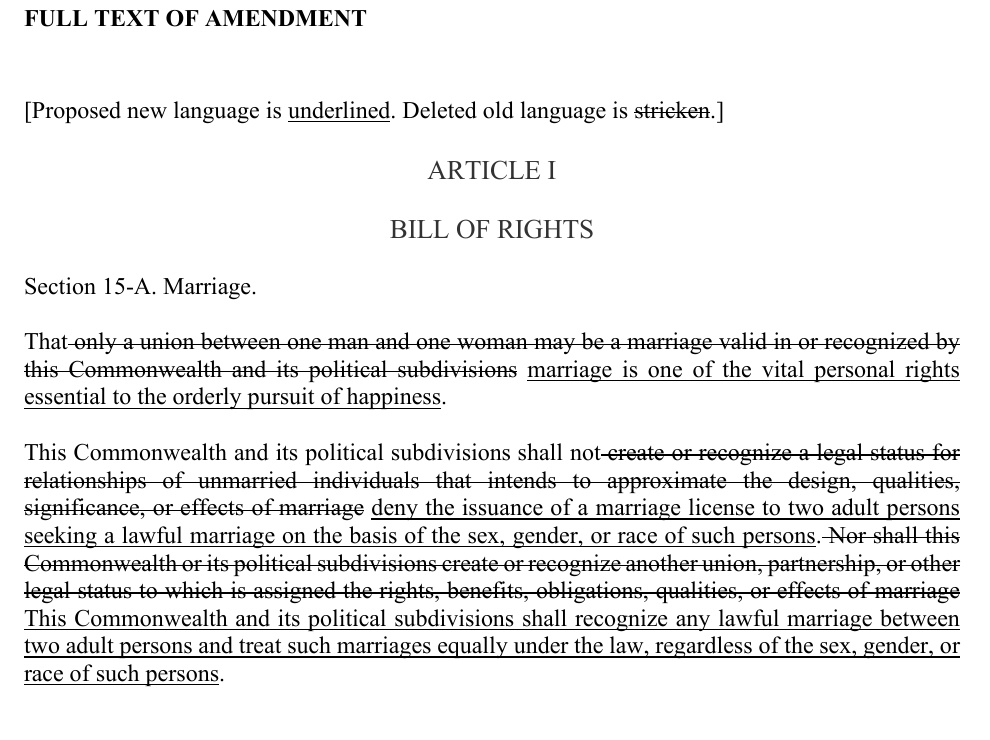
The substantive question is whether Virginia should align its own constitution with an affirmative guarantee of marriage equality rather than continue to rely on a conflicting provision being unenforceable. A voter can understand that choice without assuming a particular future Supreme Court decision. Future scenarios may explain why proponents or opponents care about constitutional wording, but a scenario is not an event that has already happened.
This measure also shows why the words regardless of race belong in a complete summary. The proposed guarantee is not limited to one category of couple, even though debate may focus on same-sex marriage. At the same time, a campaign should not use the inclusion of several categories to imply that every legal question concerning marriage is resolved by the amendment. The text defines the change; broader conclusions require analysis.
For readers assessing arguments, ask whether a claim describes the present rule, the proposed state rule, or a hypothetical future legal environment. Mixing those categories can make a proposal sound either redundant or immediately catastrophic without explaining the actual choice. The responsible account identifies what voters can change in this election and what lies outside the measure’s direct effect.
The question is also about the durability and clarity of a public commitment. A constitution communicates the rules under which the state exercises authority. Replacing language is a legal act, not merely a symbolic statement. Yet the meaning of that act should be described precisely rather than inflated into a claim that one vote settles every surrounding cultural or political dispute.
For a voter, the usable comparison is present text versus proposed text, together with the current federal legal setting. That approach makes space for moral judgment while keeping the factual account stable. It allows readers to see the decision they are being offered instead of being pushed toward a conclusion through an inaccurate description of what happens the morning after the election.
Virginia Question 3 concerns restoration of voting rights after incarceration
Virginia’s third proposed amendment would automatically restore voting rights after release from incarceration for a felony conviction, while continuing to exclude people during the relevant incarceration. It would also revise the provision concerning mental incapacity so the restriction applies to people found by a court to lack the capacity to understand the act of voting. The official explanation contrasts that proposal with the existing restoration process. 30
A yes vote supports the proposed constitutional changes. A no vote leaves the current constitutional framework in place. The proposal should not be summarized as voting rights for everyone in prison, and it should not be described as a general removal of every voter qualification. Its scope is established by the text, including the qualifications and exceptions that remain. 30
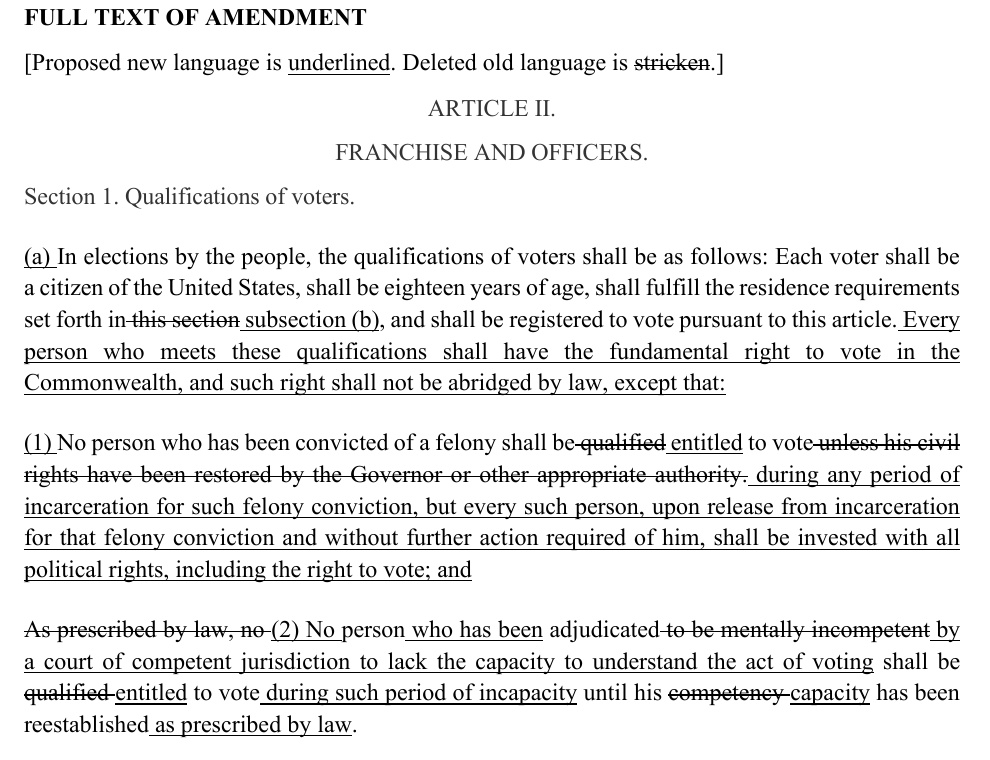
The policy choice concerns how eligibility is regained and how a restriction is defined. An automatic restoration rule can be evaluated in terms of clarity, administration, reintegration, and equal treatment. An individualized restoration system can be evaluated in terms of discretion, consistency, transparency, and burden. The voter’s judgment should address those features rather than rely solely on a label such as tough or lenient.
The capacity provision deserves separate attention because it changes a different kind of eligibility determination. A broad finding about incapacity is not the same thing as a specific finding about understanding the act of voting. An accurate explanation should preserve that distinction and avoid using disability as shorthand for inability to participate. The relevant legal determination is the one described in the proposed language.
Implementation questions are legitimate even when the constitutional direction seems clear. How would officials communicate a restored right? How would registration systems be updated? How would an affected person verify eligibility? Those are questions to ask of the responsible administration. They should not be answered through invented assurances or assumptions about practices that have not yet been documented.
For a nationwide reader, this example reinforces that eligibility rules differ by jurisdiction. A person should not use Virginia’s proposal as instructions for another state or treat an unapproved amendment as current law. The appropriate election office and governing legal record remain the authoritative sources for an individual’s present eligibility.
The larger democratic issue is how a society defines participation after a criminal sentence and how precisely it draws restrictions related to capacity. Voters may hold strong views about those questions. The task of the guide is to identify the actual proposed change so those views can be applied to the right decision, with the scope, timing, and legal status kept visible.
Georgia Amendment 1 concerns the acreage limit for conservation-use taxation
Georgia’s first statewide constitutional question asks whether the maximum acreage qualifying for assessment and taxation as bona fide conservation-use property should increase from 2,000 acres to 4,000 acres. Official county sample ballots identify House Resolution 32 as the measure. A yes vote supports the higher maximum. A no vote rejects this proposed increase. The question concerns a qualification limit for a tax treatment, not a direct cash payment to every farmer. 17 18
The numbers are straightforward, but their meaning deserves care. Doubling the acreage ceiling does not mean every qualifying property’s tax bill would be cut in half. It does not establish that every landowner would become eligible. The actual assessment rules, qualifications, and property circumstances matter. The ballot’s acreage comparison should not be turned into an unsupported claim about a universal dollar benefit.

The policy argument can be examined through both land stewardship and public finance. What kinds of properties would be newly affected by the higher ceiling? How would the tax treatment interact with local revenue? What evidence supports a claim that the change would preserve working land? What safeguards or conditions govern eligibility? Those are substantive questions for the underlying law and fiscal record, not facts established by the measure’s title alone.
A voter can favor agricultural preservation while asking whether a higher ceiling is the best instrument. A voter can worry about revenue effects while acknowledging that the current system already provides a form of conservation-use treatment. The relevant comparison is the proposed rule against the existing rule. Treating the decision as though it created the entire system from nothing would obscure the baseline.
This example also illustrates the difference between an appealing purpose and a legal mechanism. The ballot’s statement of purpose can help explain why sponsors proposed the change. The mechanism is the acreage qualification. Whether the purpose is achieved depends on how the measure operates after adoption and on evidence about affected properties and behavior. A statement of intent is not a measured outcome.
For national readers, the broader lesson is to identify what a number actually measures. Acres are an area unit. An assessment rule determines a taxable value under applicable law. A tax rate determines another part of the calculation. A campaign can combine those ideas in a persuasive sentence, but a voter should separate them before accepting a claim about the resulting bill. The measure is understandable without inventing a fiscal forecast the official ballot does not provide.
Georgia Amendment 2 would make all probate-judge elections nonpartisan
Georgia’s second statewide question proposes requiring all probate court judges to be elected in nonpartisan elections. Official sample ballots identify House Resolution 251 as the underlying resolution. A yes vote supports the statewide nonpartisan-election requirement. A no vote rejects the proposed constitutional change. The measure concerns the election format; it does not itself declare that every candidate or judge will have no political views. 17 18
The word nonpartisan can describe a ballot arrangement without establishing a person’s independence. A candidate may hold political beliefs, receive endorsements, or be perceived as aligned with a group even when a party designation does not appear in the contest. The substantive evaluation is therefore how the election structure affects voter information, accountability, and the judiciary’s role. The label alone cannot settle those questions.
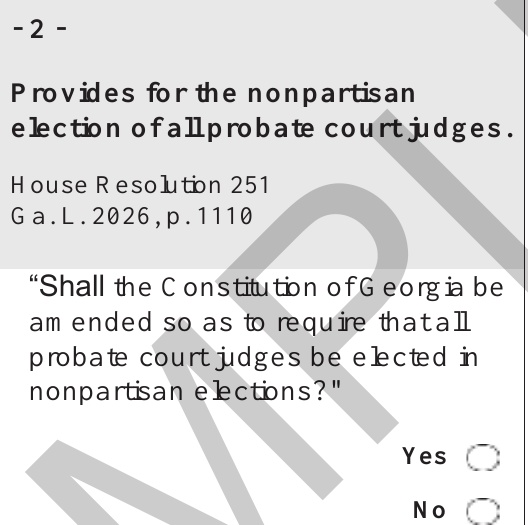
A supporter might value reducing formal party competition in judicial selection. A critic might worry that removing a familiar cue makes it harder for voters to evaluate candidates. Those are analytical arguments a voter can consider. They should not be presented as findings that the proposed system necessarily produces better or worse judges. Demonstrating such an effect would require evidence beyond the ballot text.
Voters should also distinguish selection method from jurisdiction. A change in how judges are elected is not automatically a change in what their courts are authorized to decide. If a campaign claims that the measure expands or contracts court powers, the relevant legal provision should be identified. The official question establishes an election-format proposal. Broader claims need a separate record.
For a voter facing an unfamiliar judicial contest, the practical response is to seek professional background, qualifications, conduct information, and a clear account of the court’s work. That remains valuable under either partisan or nonpartisan selection. A party designation may provide information, but it is not a complete evaluation. The absence of a designation may remove one cue, but it does not make evaluation impossible.
The nationwide significance of this example is institutional. Voters are sometimes asked to change the way future choices will be presented, rather than choose only the people currently running. Those design decisions can receive less attention because they lack the drama of a candidate contest. They still deserve a full explanation of what changes, what remains outside the proposal, and what evidence would be needed to assess the consequences. Georgia’s question offers a clear case of why the structure of an election can itself be a ballot issue.
Georgia Amendment 3 would authorize a dedicated emergency communications fund
Georgia’s third statewide constitutional question would authorize the General Assembly to dedicate specified existing revenues, including revenues reallocated by law, to a nonlapsing fund for expansion, maintenance, and operation of emergency 9-1-1 systems. The sample ballots identify House Resolution 1243. A yes vote supports the authorization. A no vote rejects this proposed constitutional authority. The question does not itself establish that a particular county has received a completed system upgrade. 17 18
Several terms carry the substance. Authorization permits an institution to act; it is not the same as every subsequent appropriation or project decision. Dedicated revenues are assigned to a defined purpose rather than being described simply as unrestricted money. A nonlapsing fund concerns the treatment of balances over time. These features tell voters how the financial arrangement is intended to work, but they do not by themselves measure service performance.
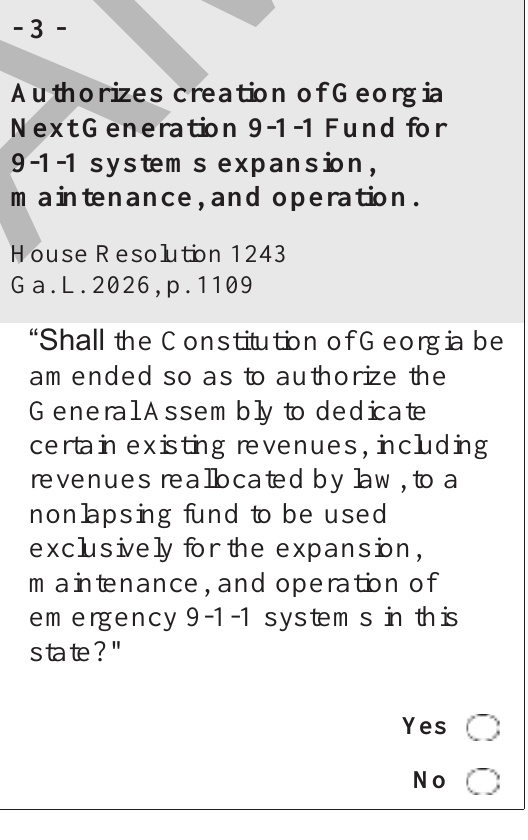
The relevant public-service questions are concrete. What needs have been identified? How would projects be prioritized? Which costs concern expansion, which concern maintenance, and which concern ongoing operations? How would performance and spending be reported? A voter can support modern emergency communications while still asking whether the financing structure supplies adequate oversight and sustainable support.
The reference to existing revenues also needs a careful reading. It should not be casually rewritten as a new tax, nor should it be treated as proof that reallocating money has no tradeoff. If revenue is redirected from another use, the effect depends on the actual legal and budget decisions. The ballot’s authorization establishes a possible route. A claim about the eventual budget consequence requires the implementing record.
A campaign may feature a compelling example of an emergency call or system failure. Such an example can explain why the service matters. It cannot substitute for a documented account of how the proposed fund would address the problem. The causal chain should be visible: authority, revenue dedication, spending decisions, implementation, and measured service results.
For a national audience, this is a useful reminder that infrastructure questions are not always framed as large construction bonds. They may concern the rules governing money over time. A fund can create a more durable administrative arrangement without guaranteeing a specific operational outcome. The appropriate election explanation names the legal choice and the public purpose, then identifies what must happen afterward before anyone can claim that the promised improvement has been delivered.
A Bibb County tax question shows why statewide summaries are not enough
Bibb County’s published sample ballot includes two local homestead-exemption questions, one for school-district taxes and one for county taxes. The listed exemptions depend on age: $17,000 of assessed value for residents ages 65–74, $32,000 for ages 75–84, and the full assessed value for residents 85 and older. The ballot identifies separate legislation for the school and county proposals. These are local questions, not statewide benefits for every Georgian. 18
The phrase assessed value is the key to avoiding a misleading dollar claim. An exemption of $17,000 in assessed value is not a $17,000 payment and is not automatically a $17,000 reduction in the tax bill. The bill depends on the applicable taxable value, rates, qualifications, and other relevant rules. A voter should not infer the household saving from the exemption amount alone.
The two questions also deserve separate votes and separate analysis. A school-district exemption concerns one category of taxation; a county exemption concerns another. A campaign may discuss them together because the age bands are similar. That does not make the legal decisions identical. A voter may evaluate the service and revenue consequences differently for each taxing body.
A yes vote on a particular question would approve the act described in that question. A no vote would reject that proposed exemption change. Neither choice establishes the voter’s motive. Someone may support relief for older homeowners but disagree with the design. Another may favor the design and want more information about its fiscal effect. The ballot records the legal choice, not the full reasoning behind it.
For an affected household, the next useful document is an official explanation of eligibility and the calculation. For the public as a whole, useful questions include how many properties may qualify, how the revenue effect is estimated, and how any resulting budget change would be addressed. The ballot text establishes the proposed exemption; it does not by itself establish a total fiscal cost or the saving for a particular household.
Two readers in the same state may face different tax questions. Two readers in the same county may live in different districts. A composite ballot can contain more contests than one person is entitled to vote in. The path to a complete personal voting plan is therefore national context, state and local records, and the assigned ballot for the voter’s address. The final step establishes which choices apply to the individual household. 3 18
Missouri Amendment 3 would replace the reproductive-rights amendment approved in 2024
Missouri’s November ballot contains five statewide questions: Amendments 3, 6, 7 and 8, and Proposition A. These are the measures certified for November 3, not the separate questions listed for the August primary. The Secretary of State’s election page separates the two dates. A measure number without its election date can therefore send a voter to the wrong proposal. The November questions cover reproductive rights, citizen initiatives, a public investment fund, sheriffs and congressional boundaries. Each calls for a separate decision. 47 51
Amendment 3 asks voters to repeal Article I, Section 36, the reproductive-health provision approved in 2024, and replace that framework with the proposed restrictions. The official explanation says a yes vote would permit abortion restrictions limiting access to medical emergencies, fetal anomalies, and rape or incest under twelve weeks’ gestation. It also describes informed and voluntary consent requirements, including parental or judicial consent for minors, and restrictions on public funding with limited exceptions. The proposal is a constitutional change, rather than a vote for a particular medical provider or a candidate’s broader health platform. 47 48

The same amendment includes restrictions on gender-transition procedures for minors. The official explanation identifies surgeries, cross-sex hormones and puberty-blocking drugs, with exceptions for specified medical conditions. Those provisions belong in the description because a voter cannot split this question into separate votes on abortion and treatment for minors. A person who agrees with one component and disagrees with another must evaluate the combined legal text offered by Amendment 3. 47 48
A no vote would leave the 2024 reproductive-rights provision in the constitution and reject the replacement proposed by this measure. The official explanation describes the existing provision as protecting access to abortion through fetal viability. A no vote would not add Amendment 3’s proposed prohibition on gender-transition procedures for minors. That is a statement about the amendment being offered, rather than a claim that no other law or litigation affects medical care. Existing statutes, court orders and a proposed constitutional provision occupy different places in the legal system. 47
For voters, the central question is which constitutional framework should govern. The practical stakes are not exhausted by a campaign’s use of the words freedom, safety or protection. Those words express values; the operative provisions determine the authority being granted or restricted. Compare the exceptions, the consent language and the treatment of minors with the existing provision. Approval would establish a new constitutional framework. It would not, by itself, document how every future medical decision or court dispute would be resolved.
Missouri Amendment 6 concerns the power to make laws by petition
Amendment 6 addresses the initiative and referendum process. Its official summary describes making that process a fundamental right, permitting courts to revise ballot summaries through litigation, and restricting legislative efforts to weaken petition powers. These are rules about how public decisions can be initiated and reviewed. They matter even to a voter who has no current petition to sign, because they shape the route through which future proposals may reach the electorate. 47
The most easily misunderstood point concerns changes to laws enacted by initiative. The official fair-ballot explanation says lawmakers would be prohibited from directly amending or changing such a law. Proposed modifications would have to return to voters, with referral requiring at least 80 percent approval in each legislative chamber. That is more demanding than saying an 80 percent legislative vote could itself rewrite the voter-enacted law. The proposed route includes another public vote. 47

The official explanation also says the measure would preserve existing signature thresholds: five percent of individual legal voters in each of two-thirds of congressional districts for a proposed law, and eight percent in each of two-thirds for a proposed constitutional amendment. It would maintain a simple statewide majority of votes cast for adoption. Those signature percentages concern qualification; the statewide majority concerns the later decision at the ballot box. They are different stages of the process and should not be added together or described as competing approval rules. 47
A yes vote would adopt the proposed protections and restrictions. A no vote would leave the current constitutional provisions governing initiatives and referenda unchanged by this measure. The choice is therefore about the balance between direct voter lawmaking and subsequent legislative authority. Support for one particular initiative does not settle that institutional question. A durable rule will also apply when future petition sponsors seek policies the same voter strongly opposes.
The tradeoff deserves attention on its own terms. Requiring a return to voters can protect an initiative against a quick legislative reversal. It can also make later adjustments more demanding, including adjustments supporters might eventually consider useful. These are consequences of the proposed decision structure, not predictions about which future law will be changed. Voters can ask whether the additional barrier is appropriate and whether the process provides the balance they want between flexibility and protection of an electoral decision.
Missouri Amendment 7 proposes an investment fund, not an immediate tax repeal
Amendment 7 would establish the Show-Me Prosperity Fund as a permanent public endowment. Its stated goal is to support state government and eventually eliminate state-imposed taxes without impairing the real value of the fund’s principal. The proposed text allows legislative appropriations into the fund and gifts, donations, grants and bequests. It directs investment through exchange-traded funds tracking the S&P 500 or a comparable successor index determined by law. These are features of the proposed financing mechanism. They are not evidence that the fund already exists or has earned the money needed to replace taxes. 49
The path to using earnings is conditional. The treasurer would first notify the legislature that the previous fiscal year’s net investment earnings were sufficient to replace the specified tax revenue. The legislature would also have to approve that notification by concurrent resolution within the stated period. Annual appropriations from the fund would be capped at three percent of its average market value over the preceding five fiscal years. The principal could not be appropriated, pledged or borrowed against. 49
The three-percent figure is a distribution limit, not a promised investment return, a household tax reduction or a guaranteed annual dividend. A five-year average is also different from the fund’s value on one trading day. Those distinctions matter because a campaign can describe the ambition of eliminating taxes without answering how large a fund would be required, where contributions would come from or how volatile earnings might affect the timetable. The proposal does not supply a guaranteed date on which taxpayers would stop paying state taxes.
The text anticipates financial failure as well as success. If the fund could not meet its obligations because of insolvency, a revenue shortfall or program failure, the legislature would retain authority to obtain lawful funding and enact or increase taxes or other revenues to maintain programs and meet the expenditures intended to be supported by the fund. The measure therefore does not promise that eliminated taxes could never return under any circumstances. It also requires periodic audits and at least quarterly public reporting of the balance and investment performance. 49
A yes vote would establish the proposed constitutional fund and its rules. A no vote would reject that constitutional change. The state’s official explanation says passage would have no immediate tax impact, although sufficient future earnings could lead to elimination of state-imposed taxes. The question before voters is whether to adopt this framework. It is not a choice between a current tax bill and an already funded replacement paying that bill today. 47
Missouri Amendment 8 concerns the office of sheriff and removal procedures
Amendment 8 would place provisions governing covered county sheriffs into the state constitution. The official explanation describes four-year elections, duties now provided by statute and removal only through a writ of quo warranto initiated by the attorney general. A yes vote would adopt the constitutional provisions. A no vote would leave current statutes governing elections, duties and removal in place unless changed by law. Rejecting the amendment would not itself abolish the office of sheriff. 47 50
The proposed text includes exceptions. It excludes a city outside a county, a charter county adjacent to such a city, and a specified category of large charter county defined by population and adjacency. Consequently, a statewide description should not promise identical effects in every jurisdiction. The definitions in the text, rather than a broad slogan about every county, establish which offices are covered. 50
For covered offices, the text addresses law-enforcement and court-related duties and staffing authority within allocated funding. The removal provision concerns a legal proceeding initiated by the attorney general. It does not say that an attorney general’s accusation alone automatically removes a sheriff. The distinction between initiating a proceeding and obtaining its result is central to understanding the authority proposed. 50
Voters are choosing a constitutional structure for the office, including how difficult it should be to change its governing rules. That question is separate from whether a voter likes the present sheriff. An institutional rule persists beyond one officeholder. Consider both independence and accountability: who can begin a removal action, what process must follow, and which governing provisions should remain subject to ordinary legislation? The amendment offers a legal answer to those questions; the ballot does not provide an individual performance review.
Missouri Proposition A asks voters to decide on congressional boundaries
Proposition A is a referendum on House Bill 1 from the 2025 second extraordinary legislative session. The certified ballot explanation says a yes vote would approve the act redrawing congressional district boundaries. It says a no vote would leave the congressional boundaries enacted in 2022 in place. The question concerns the law establishing the map, rather than a vote directly selecting a member of Congress or determining which party wins a district. 47
District boundaries define the constituencies used to elect representatives. They do not reveal how every resident will vote, and an expected partisan advantage is not a certified election result. The meaningful comparison begins with the competing boundaries and the communities assigned to each district. Claims about political effects require additional analysis of election data and assumptions; they cannot be established solely by a map’s title.
The referendum also differs from an ordinary candidate contest in how a no vote operates. Voting no rejects approval of the specified redistricting act under the certified explanation. It is not an instruction to draw an entirely new map according to the voter’s personal preferences. Voters who dislike both approaches still must understand the legal alternatives actually offered. The official sample ballot and current election-office lookup remain the authorities for the congressional contest assigned to an individual address.
Taken together, Missouri’s five questions show why a single national campaign frame is inadequate. A voter may evaluate personal rights, direct democracy, public finance, law-enforcement accountability and representation differently. Agreement with one party’s congressional candidate does not require the same answer to every measure. The ballot permits separate judgments, and the proposed text gives each judgment a concrete object.
Health-care promises need an eligibility test and an authority test
Health care can be a deeply personal reason to vote, but campaign language often compresses several different problems into the word access. A voter may be worried about insurance eligibility, premiums, deductibles, drug costs, provider availability, travel, or continuity of treatment. These burdens can overlap without being solved by the same policy. A candidate should identify which one the proposal addresses.
Begin with authority. Is the candidate proposing a federal law, a state rule, a budget appropriation, a regulatory action, or local service support? Which institution would have to agree? A promise from a candidate for an office without the relevant power needs an explanation of how that candidate would influence the responsible institution. Advocacy can matter, but it should be described as advocacy.
Then examine eligibility. Who would qualify, on what date, and under what conditions? Would the proposal change an insurance premium, a payment at the pharmacy, or reimbursement to a provider? Does the advertised amount concern a monthly charge, an annual maximum, or a tax adjustment? A number without a unit and a covered population can be technically accurate in one context and misleading in another.
A hypothetical drug-price proposal illustrates the problem. A candidate might cite a lower price for a defined group of patients. That figure should not be presented as the price every patient will pay. The actual rules may depend on coverage, the product, the program, and implementation. A responsible campaign explanation specifies those conditions instead of relying on a familiar dollar figure to imply universal relief.
The same discipline applies to claims about hospitals or clinics. Funding an improvement is different from completing it. Opening a facility is different from ensuring staffing. More capacity in one location does not automatically establish equal access across a state. Voters should ask what outcome the proposal intends to change and what evidence would measure it.
Each health-care plan can be evaluated on the same terms: authority, eligibility, financing, timing, and observed results. A voter can bring strong values and personal experience to that evaluation while insisting that the factual account remain precise. The question is not whether a candidate expresses concern. It is whether the candidate can describe a lawful, financed, and administratively credible route from the campaign promise to the care people need.
Immigration and public safety require distinctions that slogans erase
A voter concerned about immigration or public safety deserves a specific account of the proposed policy. A campaign can invoke security, fairness, enforcement, or humanity without explaining the legal mechanism. The first useful question is which decision the candidate would make in the office being sought. The second is which people and circumstances the proposal actually covers.
Federal and state offices do not possess interchangeable powers. The Constitution assigns national legislative responsibilities to Congress, while state and local institutions operate under their own legal frameworks and applicable federal law. A candidate should identify the authority behind an enforcement proposal rather than imply that any elected official can direct every agency. 2 21
Language about legal status, criminal allegations, convictions, and removal proceedings should remain precise. An accusation is not a conviction. An arrest does not establish guilt. A proposal to change enforcement priorities is not evidence that the change has occurred. A campaign’s description of a group should not replace an examination of the actual rule or the record concerning an individual.
For a public-safety proposal, ask what outcome is being measured. Does the candidate mean reported offenses, emergency response, case clearance, prosecution, victim support, or another measure? A change in one statistic is not a complete account of safety. The relevant time period, geographic area, definition, and reporting limitations should accompany any numerical claim. Without them, an apparent comparison may describe different things.
The same approach helps evaluate funding arguments. A proposal to hire personnel requires attention to recruitment, training, retention, supervision, and recurring costs. A proposal to purchase equipment requires attention to use, oversight, maintenance, and evidence of effectiveness. A promise to be tougher or more compassionate should be translated into an actual policy before voters are asked to judge its consequences.
Candidates should also explain how they would handle mistakes and protect lawful process. An enforcement system can be evaluated not only by the actions it takes but by how it identifies error, provides review, and accounts for its use of power. Those questions are compatible with concern for security and with concern for individual rights.
For readers, the aim is to avoid a false choice between taking a concern seriously and demanding evidence. A concern can be sincere while a campaign’s explanation is incomplete. A policy can pursue a legitimate goal while containing a flawed mechanism. The ballot is an opportunity to select officials who can explain the difference and accept scrutiny of both their intentions and their results.
Election confidence should be built from records rather than reassurance alone
Public confidence and actual election administration are related but distinct subjects. A survey can record distrust. A security procedure can address a particular risk. Neither alone provides a complete account of the other. The Election Assistance Commission describes safeguards such as testing, physical controls, access controls, and audits, while emphasizing that procedures vary with the systems and jurisdictions involved. That is a framework for asking informed questions, not a guarantee that no problem can ever occur. 31
A reported problem should be examined on its facts. What happened, where, when, and to which part of the process? Was the issue corrected before a ballot was cast? Did it affect a registration record, a machine interface, a printed record, transmission of preliminary results, or the actual count? What documentation is available? An election is a sequence of operations, and a problem in one operation should not be casually described as proof of a different one.
This distinction matters for viral video. A clip may show a real event while omitting the explanation, correction, or subsequent record. It may also be old or misidentified. Before drawing a conclusion, establish the original source, date, location, and context. If the relevant authority’s account is disputed, identify the dispute and supporting evidence rather than choosing the most dramatic interpretation.
The same standard should govern claims favorable to the process. A statement that everything worked perfectly is too broad without evidence. The stronger account describes the procedures used, the problems reported, the remedies, and the results of the applicable checks. Transparency about a corrected mistake can be more informative than an absolute reassurance that no mistake was possible.
Voters also need to distinguish a campaign’s allegation from a formal finding. Filing a lawsuit does not establish its factual claims. An official opening a review does not establish the result. A court declining a case on procedural grounds is different from deciding every underlying allegation on the merits. The status of the proceeding belongs in the story.
The useful civic habit is symmetrical: ask for records when the claim supports your preferred candidate and when it does not. Examine the same kind of evidence with the same level of scrutiny. Election confidence should not depend on whether the preliminary result is personally welcome. It should rest on lawful procedures, accessible records, documented correction, and an honest account of what remains uncertain. That standard leaves room for legitimate challenge while resisting unsupported claims that turn disappointment into evidence.
Find your own ballot and confirm the practical rules
The official election-office directory is the most useful bridge from this national guide to an individual voting plan. Select the state or territory, then follow the official instructions to check registration, find the assigned ballot, identify voting locations, and confirm deadlines. USA.gov also explains how sample ballots and voter guides serve different purposes: the sample establishes the choices, while a guide can provide background. 3 4
Start with the address attached to the registration record. A recent move, an outdated record, or a district boundary can affect the appropriate ballot and location. Do not assume that a polling place used in a previous election is the correct place this time. The relevant office can confirm the current arrangement. USA.gov’s polling-place guidance directs voters to state or local officials and the registration record for location and hours. 32
Next, choose a voting method available under the applicable rules. Early in-person voting, absentee voting, and voting by mail have state-specific requirements and deadlines. There is no single national deadline or identification rule covering every voting method and jurisdiction. Confirm the exact rule for the chosen method and jurisdiction. 33 34 35
If using a mailed or absentee ballot, distinguish requesting it, receiving it, completing it, returning it, and confirming its status where the jurisdiction provides that service. A deadline for one step is not automatically the deadline for another. Follow the official instructions for signatures, envelopes, identification information, and return methods. When something is unclear, obtain guidance from the responsible election office before making an assumption.
If voting in person, read the ballot instructions and review selections before casting. If equipment or a paper ballot does not reflect the intended choice, seek assistance from a poll worker before submitting it. The appropriate remedy depends on the stage and local procedure. A social-media post is not a substitute for notifying the people who can address the problem at the polling place.
Accessibility also belongs in a practical plan. Ask the election office about available accommodations or assistance that apply to the voter’s needs. The purpose is to establish the actual options rather than rely on a general assurance. A voter should be able to obtain clear instructions without being expected to infer them from an unrelated jurisdiction’s practice.
Finally, make a record of the offices and questions that require further study. A long ballot is easier to understand when each item has a job description and each measure has a clear yes-and-no explanation. Preparation is not about choosing quickly. It is about ensuring that the eventual choice corresponds to the decision the ballot actually offers.
Election night is a reporting stage rather than the end of the record
Election-night information can arrive quickly and still be incomplete. The Election Assistance Commission distinguishes unofficial results from the subsequent work of canvassing and certification. Voters should read the status attached to a reported number. An early total, a media projection, a concession, and an official certification are different events. One should not be relabeled as another simply because the public conversation has moved on. 36
The practical question is what remains uncounted or unresolved under the jurisdiction’s lawful process. Different categories of ballots, reporting schedules, or review procedures can affect the timing. A change in the order of candidates as additional results are reported is not, by itself, evidence of misconduct. A claim that a change is improper requires a specific account of the rule violated and the supporting record.
A close contest deserves particular precision. A candidate may request a review or pursue a legal remedy available under the applicable law. The existence of a request does not establish that the result is wrong. The denial of one claim does not automatically resolve every possible issue. The useful record identifies the request, the authority considering it, the decision and the questions that decision actually resolved.
The same restraint applies to ballot measures. Approval at the ballot box is a major event. It may be followed by effective dates, administrative rules, budget decisions, or litigation. A vote to authorize a fund does not establish a completed project. A tax measure’s passage does not establish the amount eventually collected. A constitutional amendment’s approval does not eliminate the need to describe subsequent interpretation accurately.
For the public, patience should not mean indifference. Follow official updates, seek the relevant records, and distinguish a delay explained by procedure from an unexplained failure to meet a requirement. Ask questions with enough specificity that they can be answered. Demanding an instant result and demanding an accurate result are not always the same instruction.
There is also a political interpretation to separate from the legal outcome. Commentators will discuss mandates, realignment, backlash, and momentum. Those can be useful arguments when grounded in evidence. They are not additional boxes voters marked. A candidate’s victory establishes who won the contest under the rules. It does not reveal every voter’s motive or authorize every policy the winner may later propose. The work of scrutiny continues after the count, when campaign intentions begin meeting the responsibilities of office.
The most useful question is what changes after this vote
A ballot becomes clearer when each choice is connected to a concrete next step. If this candidate wins, what authority will the person possess? If this measure passes, what text changes? If it fails, what remains in place? Who must act next, who pays, and what record would show whether the promised result occurred? These questions are useful across party, geography, and policy preference.
They also create a fair standard for the mood surrounding the election. People can be frustrated, hopeful, wary, determined, or conflicted for reasons that deserve to be heard. Polling can document patterns among respondents. Interviews can illuminate individual experiences. Neither should be used to invent a single national emotion or to claim that one campaign speaks for everyone. The better account preserves the difference between what is measured and what is inferred.
For candidates, the same standard means describing the office honestly. A representative should explain legislation and oversight. An executive should explain administration. A judge should explain legal responsibility. A sponsor of a measure should explain the operative text and the fiscal assumptions. Shared goals are not enough when the proposed methods differ. A voter deserves to know the method.
The 2026 midterms will be interpreted nationally, but they will be decided through specific contests and specific legal questions. The practical response is to combine the broad view with the assigned ballot. Understand the institution. Read the proposal. Compare the records. Confirm the voting rules. Then judge the choice that is actually before you, with enough clarity to recognize afterward whether the people elected and the policies approved deliver what was promised.
Find your official ballot
Choose your state or territory, then follow the election office’s instructions to find the ballot assigned to your address. The measures discussed above are selected examples; local contests and questions vary by residence.
Sources & original records
- Congressional elections and midterm elections
- United States Constitution transcription
- Sample ballots and voter guides
- Official state and local election office directory
- Reuters Ipsos original topline October 16–19 2026
- Reuters independent report on October polling
- AP NORC original October 8–12 2026 topline
- White House administration officeholders
- House official leadership roster
- Senate Class II terms
- Senate explanation of cloture
- Texas final ballot certification August 28 2026 pages 1–2 of PDF
- Ken Paxton campaign stated priorities
- James Talarico campaign stated priorities
- Associated Press independent Texas campaign report
- Clayton County official composite ballot November 3 2026
- Bibb County official sample ballot November 3 2026
- Ossoff official biography statements of office priorities
- National Governors Association 2026 election directory
- State and local offices and jurisdictional variation
- California Proposition 40 official summary
- California Proposition 40 Legislative Analyst explanation
- California Proposition 41 official summary
- California Proposition 41 Legislative Analyst explanation
- California Proposition 42 official summary
- California Proposition 42 Legislative Analyst explanation
- Virginia Question 1 official explanation and proposed text
- Virginia Question 2 official explanation and proposed text
- Virginia Question 3 official explanation and proposed text
- Election Assistance Commission security procedures and limits
- Official polling-place guidance
- Absentee and mail voting guidance
- Early in-person voting guidance
- State voter identification requirements guidance
- EAC results canvass and certification
- University of Michigan final October 2026 consumer survey release
- Reuters independent October 23 consumer-sentiment report
- Collins official House membership record
- Governors powers and authority
- FOX 5 independent explanation of Georgia amendments
- WMAZ independent explanation of Bibb exemptions
- KQED independent California Proposition 40 guide
- CalMatters independent Proposition 41 guide
- Virginia official proposed amendments poster
- Ballotpedia independent Virginia measures index
- Missouri certified November 2026 measures and official explanations
- Missouri Amendment 3 full proposed constitutional text
- Missouri Amendment 7 full proposed constitutional text
- Missouri Amendment 8 full proposed constitutional text
- The Beacon independent overview of five Missouri measures