
It targets recognition
A union’s name and visual identity help workers understand who is organizing, where to get updates, and how to join. Restricting that identity can make the campaign less visible.
Starbucks says it is defending its name, logo, and brand from misuse. Starbucks Workers United says the lawsuit is another pressure point in a years-long fight over whether union baristas can win a first contract with real pay, staffing, safety, and enforcement rights.
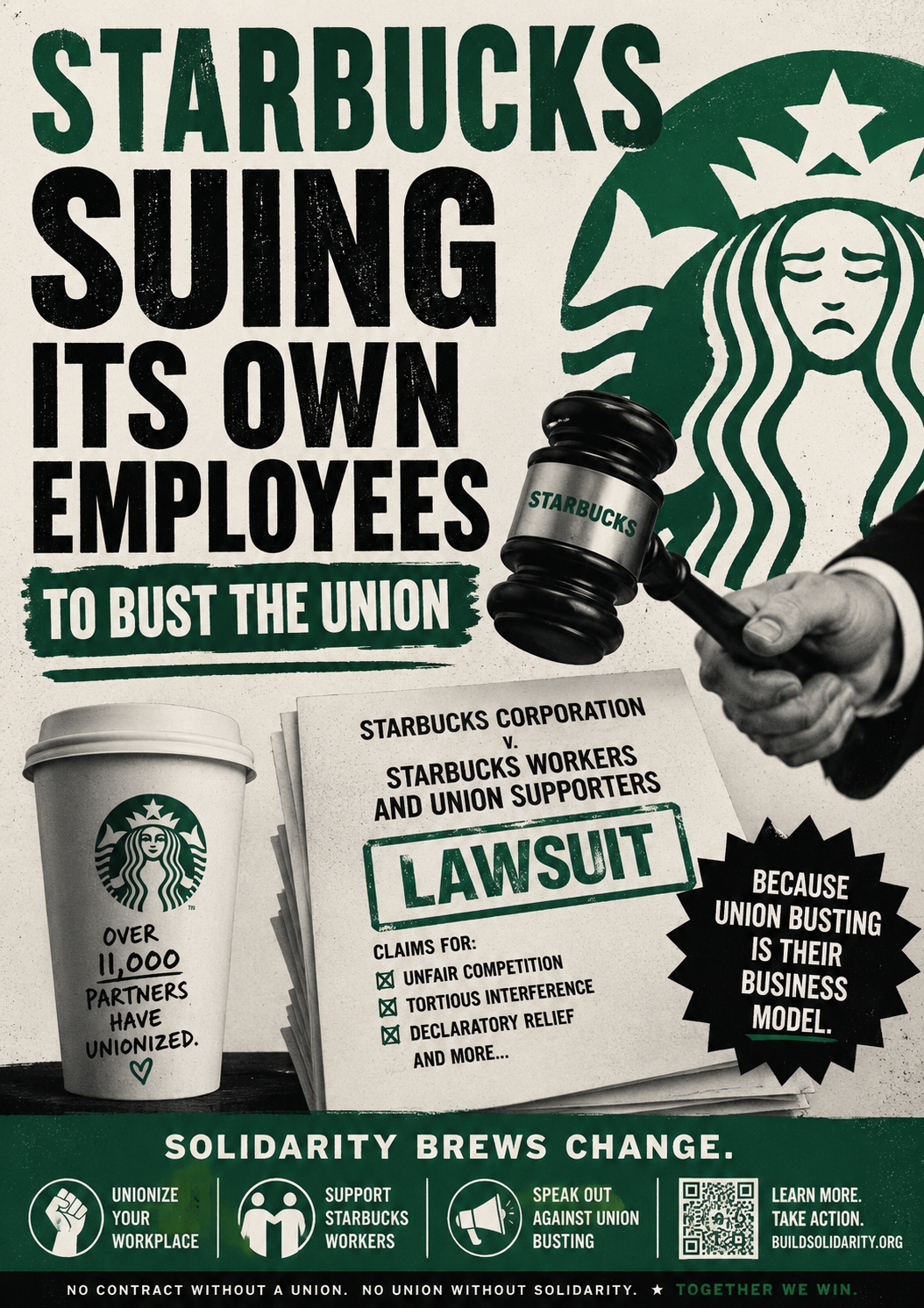
This article is about the lawsuit and how a brand-protection case fits into the larger effort to blunt or break the union campaign.
The public story is not just “Starbucks sued.” The sharper story is that Starbucks used trademark law against the union organizing its stores, while workers were still fighting for a first contract. That matters because a first contract is where union rights become practical workplace rights: pay rules, minimum staffing, grievance rights, job security, health-and-safety language, and protections against arbitrary discipline.
The company’s legal theory is straightforward: Starbucks argues the union’s name, circular green imagery, merchandise, and social media could confuse customers or dilute the Starbucks brand. The union’s answer is also straightforward: workers need to identify the company they work for, and the name “Starbucks Workers United” is central to the organizing campaign.
The lawsuit therefore has two audiences. In court, it is a trademark dispute. In the public square, it is a power dispute: can a corporation use brand-protection law to make its workers’ union harder to recognize, support, fund, and organize around?
Say: “Starbucks is suing its workers’ union over name and logo use while baristas are fighting for a first contract.” That is stronger and more accurate than saying Starbucks is suing every employee personally.
The facts below separate the court record from the public interpretation of the litigation strategy.
| Fact | What happened | Why it matters |
|---|---|---|
| Verified | Workers United filed a federal trademark/declaratory judgment case against Starbucks in the Eastern District of Pennsylvania on April 3, 2026. | The union sought a court declaration that it could continue using the Starbucks name and related organizing identity. |
| Verified | Starbucks later filed a federal trademark case in Iowa accusing the union and related entities of infringing, diluting, and damaging Starbucks trademarks. | The company’s demand would restrict how the union presents itself to workers, customers, donors, and the public. |
| Verified | Starbucks says unions may identify an employer for protected organizing activity, but that this does not permit broader brand use on merchandise or political messaging. | This is the company’s cleanest legal frame: brand protection, consumer confusion, and trademark dilution. |
| Needs care | The lawsuit does not name every barista as an individual defendant. | The audience-facing claim should be that Starbucks is suing the workers’ union, not that it sued every employee personally. |
| Verified | Workers United says the litigation should be resolved alongside hundreds of labor-law disputes so the parties can complete a fair contract. | That connects the trademark lawsuit directly to the union’s claim that Starbucks is delaying or obstructing the labor process. |
The lawsuit can affect the union even before a judge decides the merits.
A union’s name and visual identity help workers understand who is organizing, where to get updates, and how to join. Restricting that identity can make the campaign less visible.
Litigation forces a union to spend time, money, legal effort, and public messaging energy defending its basic identity while bargaining is still unresolved.
A trademark threat can make supporters, vendors, donors, and workers more cautious about using union materials, shirts, signs, social posts, or merchandise.
Instead of focusing on wages, staffing, and safety, the legal fight can make the public conversation about brand control and corporate reputation.
Workers voted to unionize so they could bargain. Every side dispute can push the central question further away: when will there be a binding first contract?
To other stores, a lawsuit can look like a warning: organizing may bring legal conflict, not just bargaining.
Starbucks, the union, and the courts are speaking from different positions.
“Not a free pass to use, dilute, and damage a famous brand.”Starbucks position reported by Courthouse News, June 2026
“Union baristas have never stopped fighting for a fair contract.”Workers United statement reported by Courthouse News, June 2026
“A preliminary injunction is an ‘extraordinary’ equitable remedy.”U.S. Supreme Court, Starbucks Corp. v. McKinney, 2024
The Supreme Court case did not decide the trademark lawsuit. It matters because it changed the legal standard for NLRB emergency injunctions, making the broader Starbucks labor-law battlefield harder for workers and regulators to navigate quickly.
The lawsuit should not distract from the contract demands behind the organizing campaign.
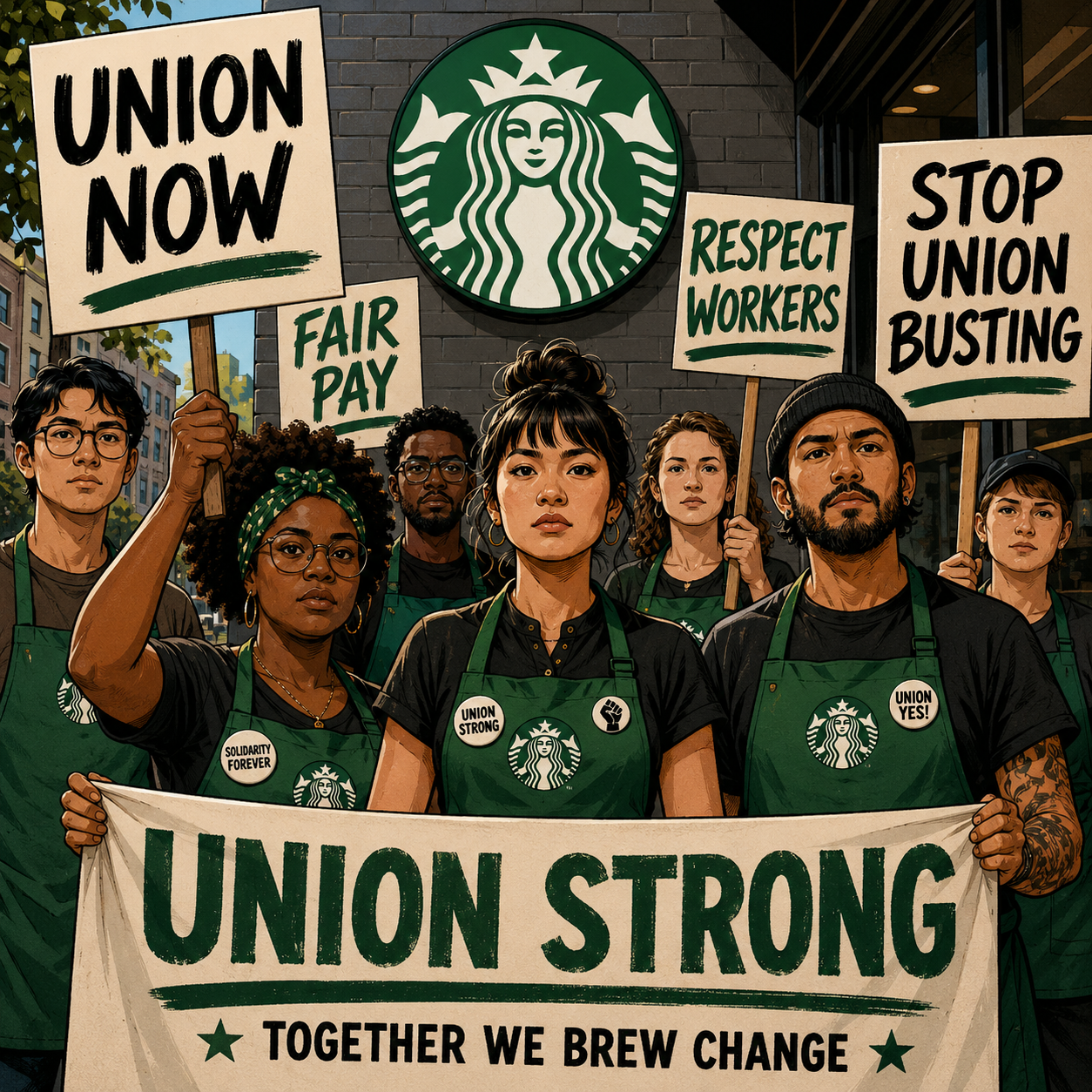
Starbucks Workers United says its current priorities include a $17/hour wage floor for the lowest-paid union baristas, 4% annual raises, three workers on the floor at all times, and more available hours for current employees before stores hire new workers.
The union also lists nondiscrimination protections, just-cause discipline, job-impact support when stores close or operations change, grievance procedures, a fair dress code, and health-and-safety improvements.
Those demands explain why the trademark lawsuit is so controversial. To workers, the case is not an isolated fight about logos. It is another legal fight occurring while core economic and workplace issues remain unsettled.
The exact litigation bill is not public, so the honest comparison is about scale and priorities.
What can be said carefully: Starbucks has not publicly disclosed the total cost of the trademark litigation. It would be inaccurate to claim those exact legal dollars alone would fund every worker demand. But it is fair to ask why a company with billions in annual revenue, shareholder spending, and executive compensation is still fighting a union over identity while baristas are asking for a first contract.
*Illustration only: 12,000 baristas × $1/hour × 20 hours/week × 52 weeks. This is not a complete contract-cost estimate and excludes taxes, benefits, wage compression, scheduling changes, and other contract terms.
A short chronology of the union campaign, bargaining, and legal pressure points.
Workers at a Buffalo Starbucks voted to unionize, launching the modern Starbucks Workers United campaign.
Starbucks and Workers United sued each other after a union social media controversy, with Starbucks raising trademark and brand-harm claims.
Starbucks and Workers United announced a “path forward” that included talks on collective bargaining and legal-dispute resolution.
The Supreme Court ruled for Starbucks in Starbucks Corp. v. McKinney, requiring the NLRB to meet the traditional four-factor test for preliminary injunctions.
Union delegates rejected a proposed framework that Workers United said failed to improve first-year wages or benefits and did not address chronic understaffing.
Workers United filed a Pennsylvania federal trademark/declaratory judgment case against Starbucks.
Starbucks filed a federal trademark case in Iowa, again placing union name and logo use at the center of the fight.
As of July 6, 2026, the trademark fight appears to be active litigation, not a resolved case.
The clearest public record shows two related federal trademark cases moving on parallel tracks. Workers United filed first in the Eastern District of Pennsylvania on April 3, 2026, asking a federal judge for a declaratory judgment that its use of the Starbucks Workers United name and affiliated logo does not violate Starbucks’ trademark rights. That case is listed as Workers United v. Starbucks Corporation, No. 2:26-cv-02202, before Judge Michael M. Baylson.
Starbucks then filed its own case in the Southern District of Iowa on June 18, 2026, against Workers United, the Chicago and Midwest Regional Joint Board, and Iowa City Starbucks Workers United. The Iowa case is listed as Starbucks Corporation v. Workers United et al., No. 3:26-cv-00054, and asserts federal trademark infringement claims under the Lanham Act.
What has not happened publicly: there is no public indication that either case has ended in a final judgment, permanent injunction, settlement, or court-approved agreement. That means the dispute is still best described as pending litigation over the union’s name, logo, and related public-facing materials.
| Case | Current public status | Why readers should care |
|---|---|---|
| Workers United v. Starbucks Corporation | Filed April 3, 2026 in the Eastern District of Pennsylvania as a declaratory-judgment trademark case. | The union is asking the court to confirm that its name and logo use are lawful, rather than waiting only to defend against Starbucks’ claims. |
| Starbucks Corporation v. Workers United et al. | Filed June 18, 2026 in the Southern District of Iowa as a trademark infringement case. | Starbucks is asking a court to restrict the union’s use of Starbucks-related branding, which could affect the union’s visibility and public identity. |
| First-contract fight | Still separate from the trademark docket but politically connected to it. | The lawsuit is unfolding while baristas continue to press for wages, hours, staffing, safety rules, and contract enforcement. |
Plain-English status: the case is not over. Starbucks has not yet won a final ruling forcing the union to abandon its name or logo, and Workers United has not yet won a final ruling confirming that its use is protected. Until a court rules, the lawsuit remains part of the larger pressure campaign around whether Starbucks Workers United can keep organizing under a recognizable public identity while bargaining remains unresolved.
The practical question is whether workers can organize without losing the public identity of their own campaign.
Subtle source list for readers who want to verify the court record, worker demands, legal context, and company financials.
A public argument should be forceful, but it also needs to be accurate.
The cleanest conclusion is this: Starbucks says the lawsuit is about protecting its brand. Starbucks Workers United says the lawsuit is part of a broader pattern that pressures workers, delays bargaining, and makes the union campaign harder to sustain.
Whether a court treats the claim as ordinary trademark enforcement or as part of a larger labor fight, the practical effect is clear: the union is forced to defend its name and identity while baristas are still trying to secure the first contract they organized for in the first place.
That is why this story matters beyond Starbucks. If a corporation can make the name and image of a worker campaign legally risky, then the fight is not only over coffee. It is over whether workers can organize in public against one of the most recognizable brands in the world.